


Knowing how to clean dental implants is most of what keeps them healthy. An implant cannot get a cavity, but the gum around it collects plaque just like the gum around a natural tooth, and that plaque is what leads to trouble years later. The good news is that the routine takes a few minutes a day, uses tools you can buy at any pharmacy, and is the same whether you have one implant or a full arch.
Here is what to clean, which tools reach where, how the routine changes for a bridge, All-on-4 or snap-in dentures, and how often to see us for a professional cleaning.
Why cleaning around an implant matters
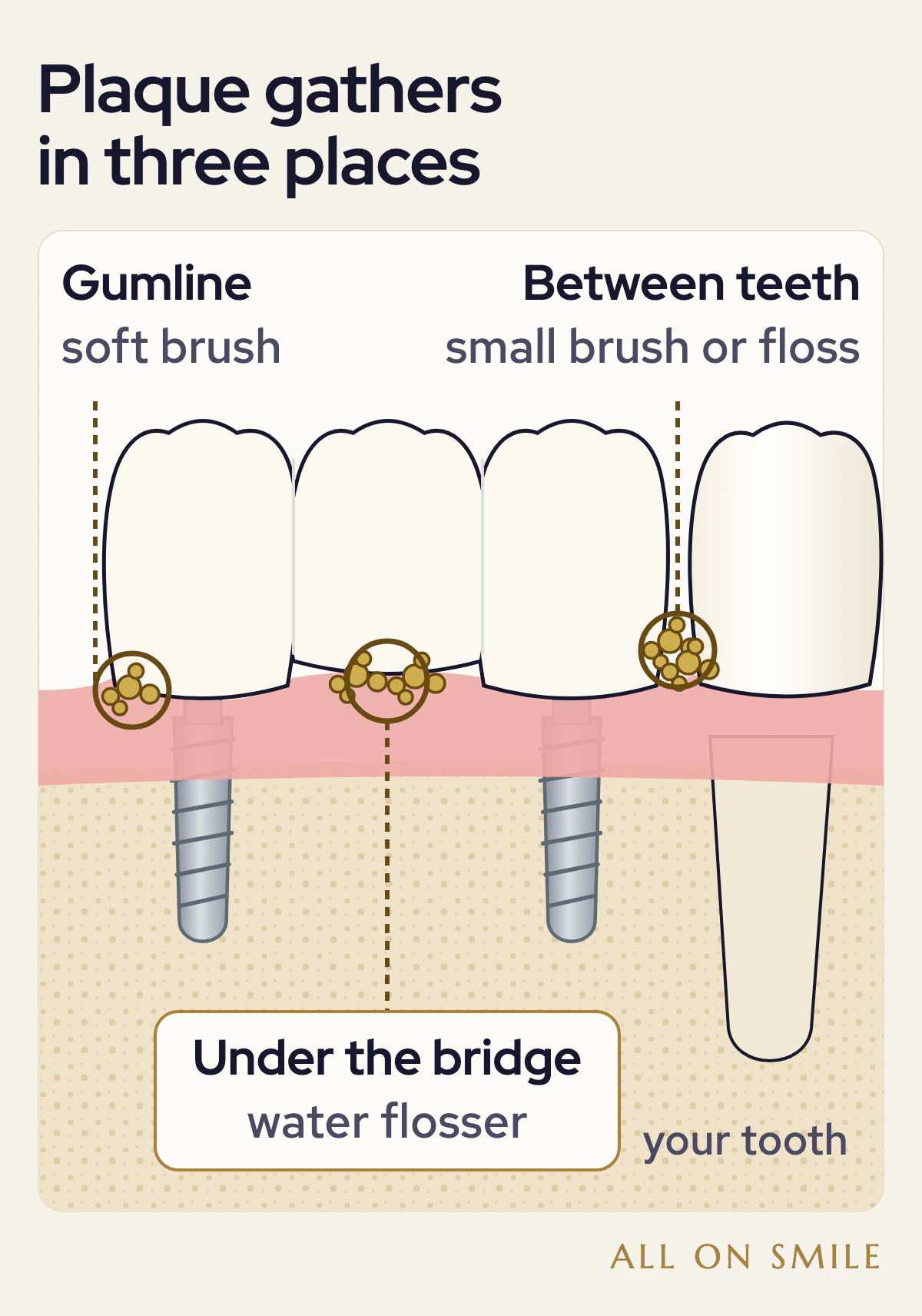
An implant is a titanium post held by bone, with a collar of gum sealed around its top. Bacteria in plaque settle at that seal, in the gap between teeth, and under any bridge that spans the gum. If plaque sits there day after day, the gum gets inflamed and starts to bleed. That early stage, called peri-implant mucositis, can be reversed with better cleaning. Left alone, it can turn into peri-implantitis, where the bone around the implant is slowly lost.
Cleaning does not need to be hard. It needs to reach three places: the gumline around each implant, the spaces between teeth, and the underside of any bridge.
Your daily routine: how to clean dental implants in a few minutes
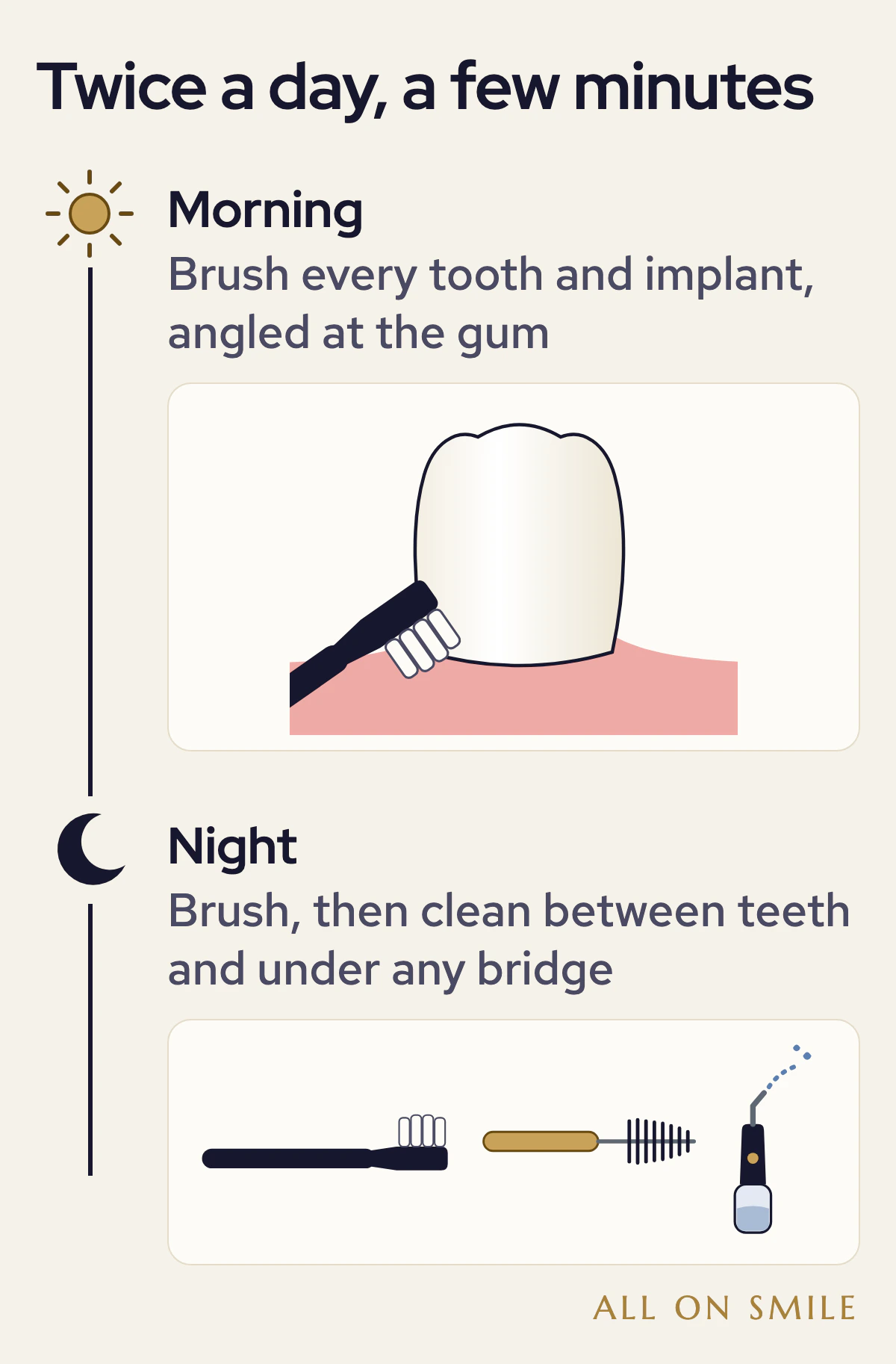
Morning and night, brush every tooth and implant with a soft brush. Tilt the bristles toward the gum so they sweep the place where the crown meets the gum, and use small circles rather than hard scrubbing. A powered toothbrush is fine and makes this easier for many people.
Once a day, usually at night, clean between and under. Use whichever of these you will actually keep doing:
- a small interdental brush, slid gently into each space between teeth
- implant floss or a floss threader, wrapped around the implant in a C shape
- a water flosser, run slowly along the gumline and under any bridge
That is the whole routine. If you can, do the in-between cleaning in front of a mirror for the first few weeks until the angles feel familiar.
The tools that reach where a toothbrush cannot
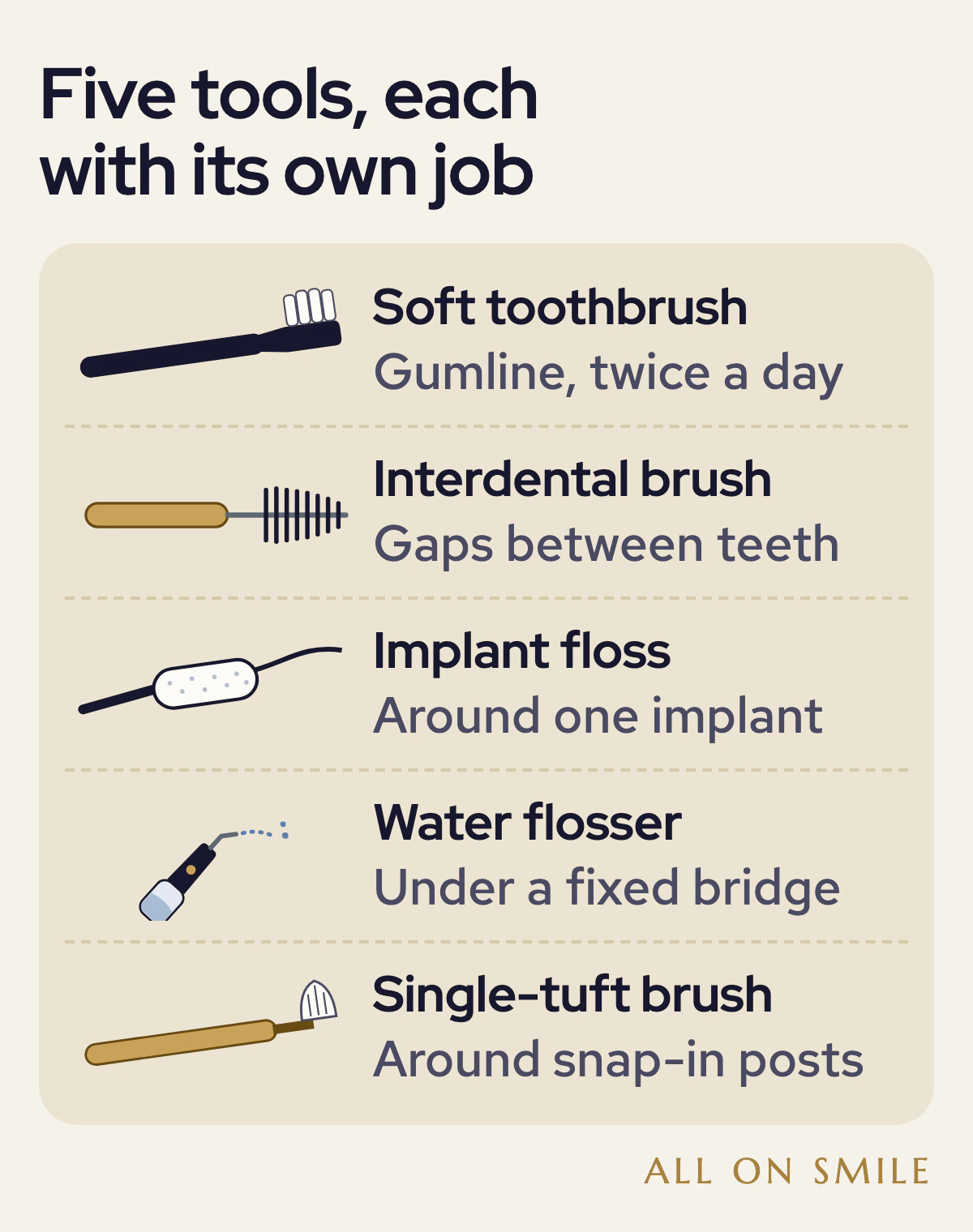
A toothbrush cleans the outside and biting surfaces well. It does not reach between teeth or under a bridge, and that is where most problems around implants start. When you buy interdental brushes, pick a size that slides in without forcing, with a plastic-coated wire so bare metal never rubs the implant.
How much do these extra tools help? The research is smaller than you might expect. In one 30-day trial of people with implants, run with a water flosser maker, bleeding went down around 18 of 22 implants in the water flosser group, compared with 6 of 18 in the string floss group. A 2025 review of home cleaning around implants found that floss, interdental brushes and water flossers all helped, but the evidence on which is best is still limited. In practice, the tool you use every day beats the perfect tool that stays in the drawer. Our All-on-4 page puts it simply: brush twice a day and clean under the bridge with a water flosser.
How to clean dental implants by type: one tooth, a bridge, All-on-4 or snap-in
A single implant
A single implant is cleaned much like a natural tooth. Brush it twice a day, angled at the gum, and clean the spaces on both sides of it once a day. Our page on single tooth implants and bridges shows how the crown sits on the implant.
An implant bridge
An implant bridge spans two or more implants, with false teeth in between that rest on the gum. Floss cannot go down between those teeth, so thread floss or a water flosser under the bridge to clean the gum beneath it.
An All-on-4 bridge
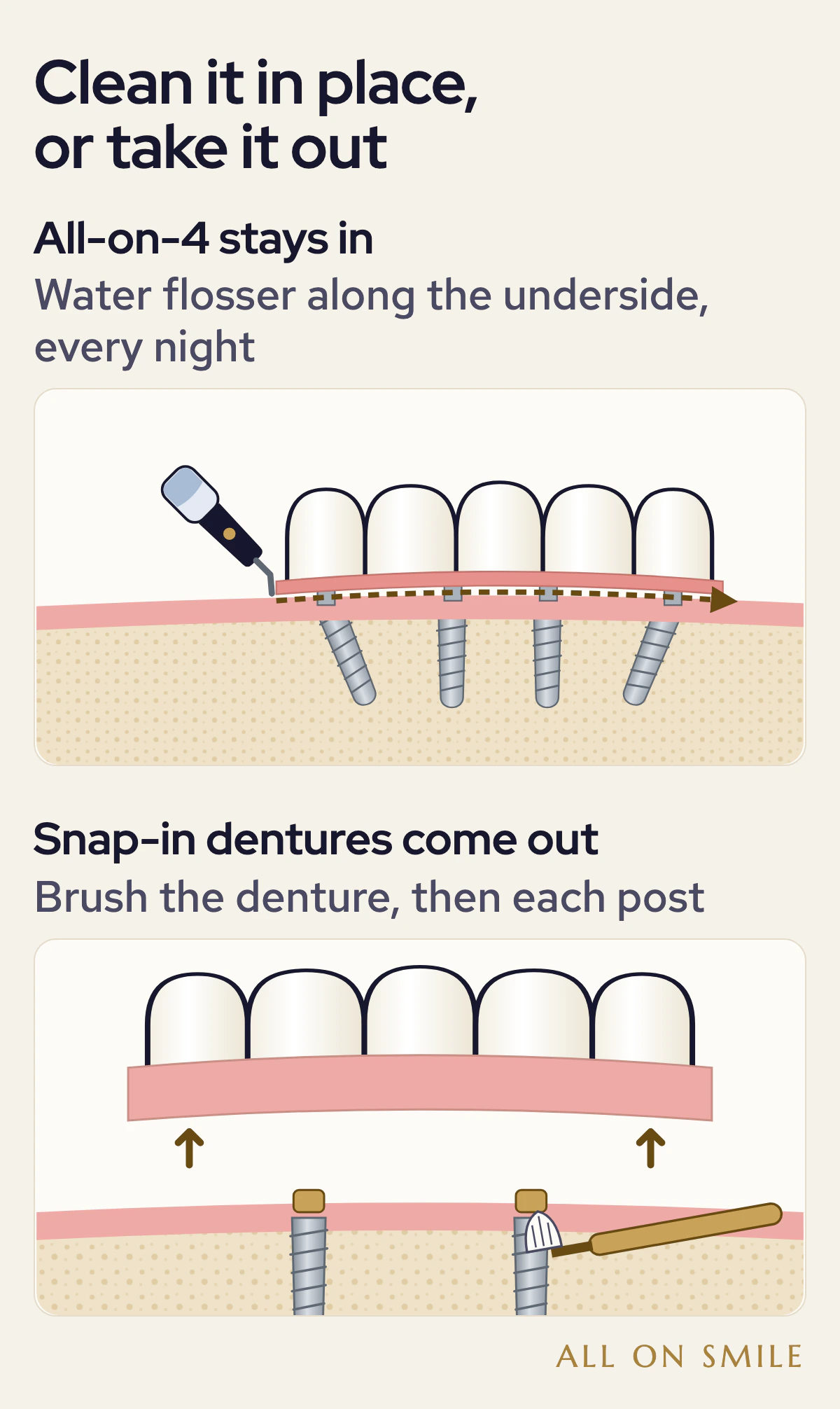
An All-on-4 bridge is fixed in place, so you do not take it out. Brush the outside and the biting surface twice a day, then run a water flosser along the gum side of the bridge, where it meets the gum, and around each of the implants underneath. That underside is the spot people miss most, because they cannot see it. Our final bridges are zirconia, which is smooth and resists stains, but plaque still needs to be cleaned off every day. If you are new to full-arch teeth, our guide to what All-on-4 is explains how the bridge is held.
Snap-in dentures
Snap-in dentures come out for cleaning. Take the denture out every day and brush it, including the small attachments inside it, with a denture brush. Then brush the implant posts in your mouth with a soft or single-tuft brush, all the way around each one. Our snap-in denture page explains how the attachments click onto the posts.
What to avoid
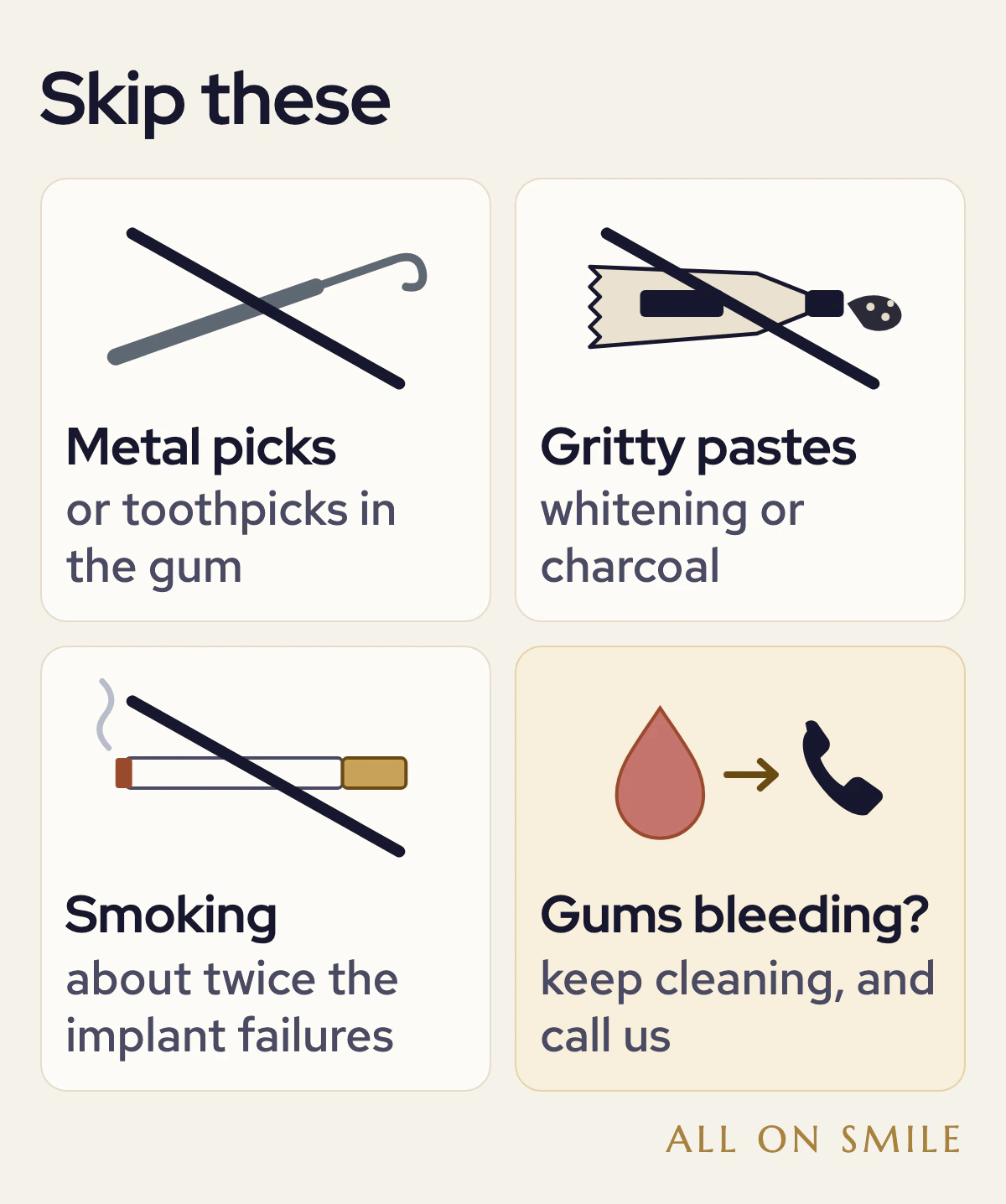
- Metal picks, toothpicks or anything sharp pushed into the gum around an implant.
- Gritty whitening or charcoal toothpastes on crowns and bridges. A regular, non-gritty toothpaste is enough.
- Skipping the in-between cleaning because the gum bleeds a little. Bleeding around an implant is a sign to clean more carefully and to call us, not to stop.
- Smoking. A 2015 review of 107 studies found implants failed about twice as often in smokers, and our post on dental implant failure rates covers the other risks.
What you eat matters less than how you clean, but our post on the dental implant diet covers the first weeks after surgery.
Professional cleanings and checkups
Home care removes most plaque. A maintenance visit removes what home care misses and catches problems while they are small. At the visit, the gum around each implant is checked for bleeding and pocket depth, the implants are cleaned with instruments that will not scratch them, and X-rays are taken when needed.
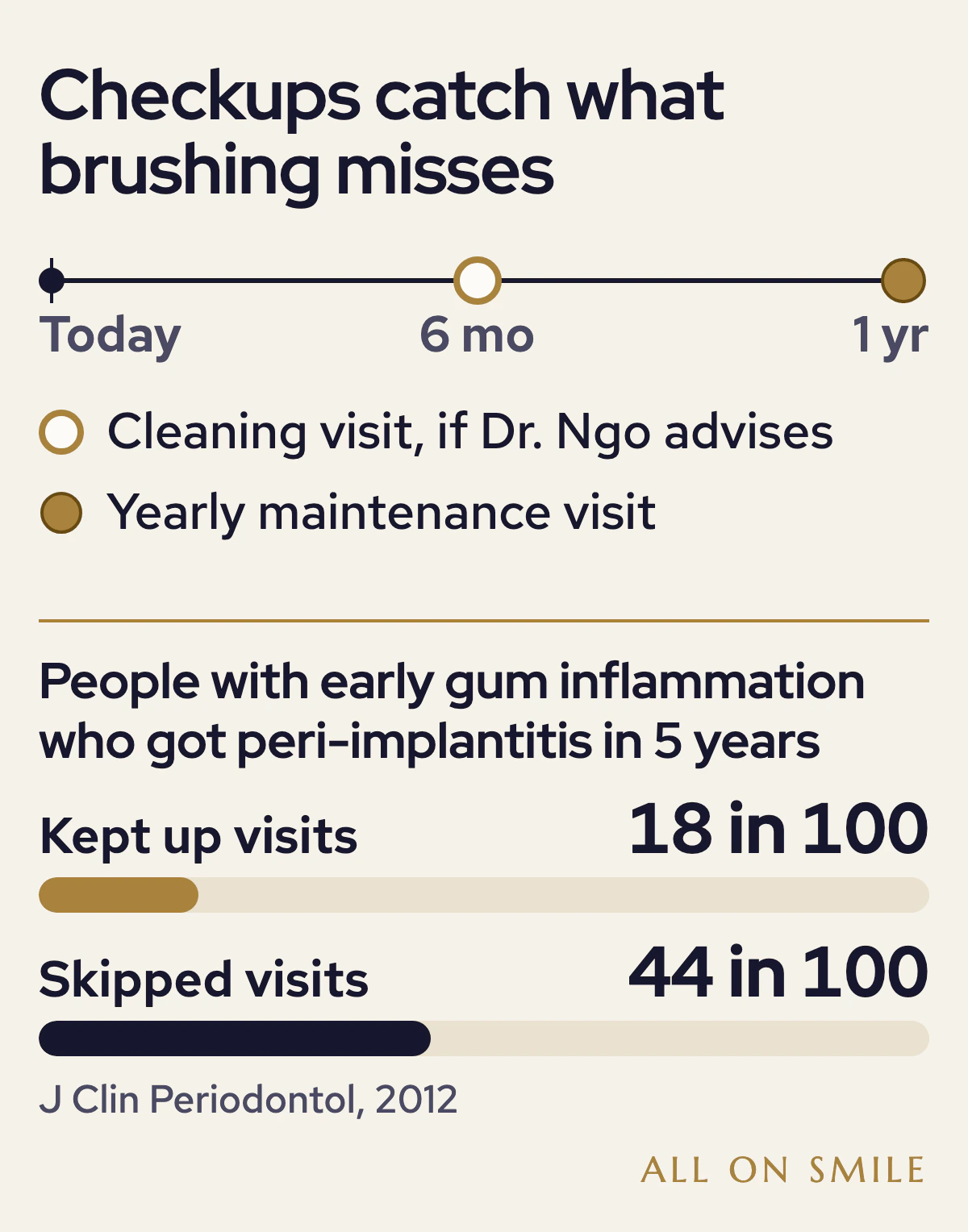
The research is clear on why these visits matter. A 5-year study followed people who already had early gum inflammation around their implants: 18 percent of those who kept up maintenance visits developed peri-implantitis, compared with 44 percent of those who did not. A 2025 study of people with fixed full-arch bridges who had not kept up maintenance found plaque on about half of the implant sites checked, and repairs to the bridge became more common the longer they had worn it.
How often should you come in? It depends on your mouth. A review of maintenance studies suggested about every 5 to 6 months as a reasonable starting point, and a 2024 review of full-arch care suggested a professional cleaning about every 6 months, with the bridge taken off for cleaning at least once a year. Dr. Ngo will tell you which schedule fits you.
Our warranty depends on the same habits. We stand behind our work with a lifetime warranty on all dental implants, as long as you follow our office hygiene protocol, such as daily home care, a yearly office maintenance visit and not smoking. Ask our office for the details.
Cleaning in the first weeks after surgery
Right after surgery, the gum needs to heal before the full routine starts. Follow the instructions we give you on the day, keep the area clean gently, and wait until we tell you before using a water flosser or interdental brushes near the new implants. Our week-by-week recovery guide covers what is normal while you heal.
Signs to call us about
Call the office if you notice any of these:
- the gum around an implant bleeds every time you clean
- the gum looks red or swollen, or leaves a bad taste
- the gum seems to be pulling back
- an implant, crown or bridge feels loose, or your bite feels different
These problems often do not hurt early on, which is why they are easy to ignore. Our article on how long dental implants last explains what helps them keep working for many years.
Common questions about cleaning dental implants
Can I use an electric toothbrush on my implants?
Yes. A powered toothbrush with a soft head is safe on implants, crowns and bridges, and many people find it easier to reach the gumline with one. Hold it at the gum and let it do the work rather than pressing hard.
Do I need special toothpaste for dental implants?
No. A regular toothpaste that is not gritty works well. Whitening and charcoal pastes are made to scrub, and crowns and bridges do not whiten anyway, so a gentle paste is the better choice for their polished surface.
Can I use mouthwash on implants?
Yes, as an extra, not a replacement. Mouthwash cannot remove the plaque that sticks to the gumline and under a bridge; only brushing and in-between cleaning can do that. If we prescribe a rinse after surgery, use it for as long as we tell you.
Can I take out my All-on-4 bridge to clean it?
No. An All-on-4 bridge is fixed to the implants, and only your dentist can take it off. You clean it in place every day, and we take it off when your maintenance schedule calls for it.
How long does cleaning take each day?
For most people, about two minutes of brushing twice a day plus a few minutes of cleaning between and under the teeth at night. With a full-arch bridge, the water flosser part takes a minute or two once you know the path.
Learn how to clean dental implants with us in Vancouver, WA
The best time to learn the routine is before your implants go in, so it is part of the plan from day one. At All On Smile Implant & Cosmetic Dentistry, Dr. Ken Ngo, DMD, FICOI, plans every implant with CBCT 3D imaging, and we will walk you through how to clean your new teeth. If you are thinking about dental implants in Vancouver, WA, your consultation is free.
Call (360) 844-2170 or book an appointment. We are open Monday through Thursday, 9am to 4pm, at 12503 SE Mill Plain Blvd Suite #222, Vancouver WA 98684.