


Zirconia vs acrylic is a question almost everyone asks once they learn how All-on-4 works, because most people wear both. In most cases you go home from surgery with fixed temporary teeth, and a few months later they are replaced by your final teeth. At many offices both sets are acrylic. At All On Smile, your temporary teeth are made right here in our office, and every final bridge is zirconia.
Here is what each material is, why the first set is temporary, how the two compare, what the research found, and how to look after zirconia teeth once you have them.
Inside each bridge
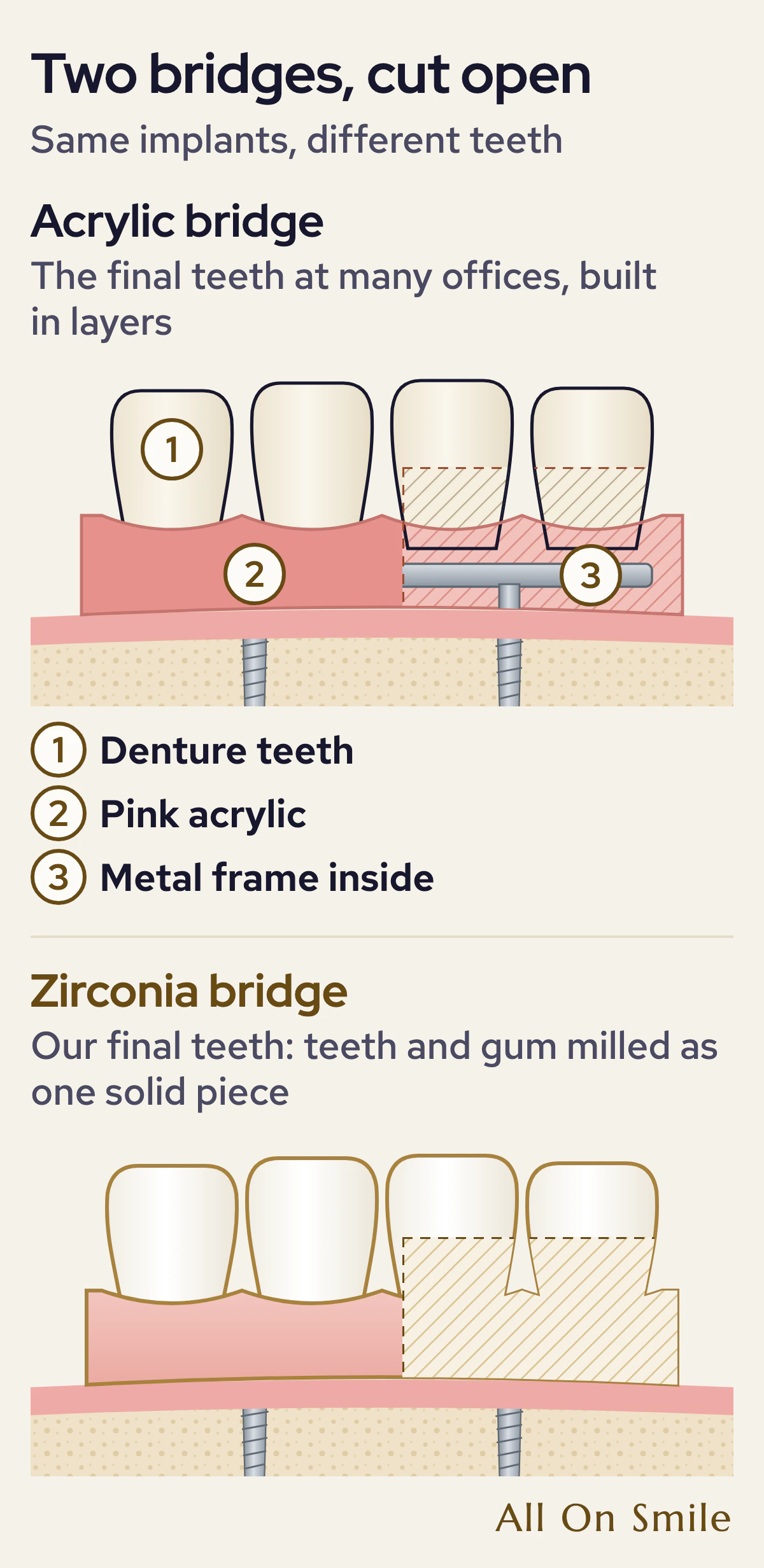
Acrylic is a hard dental plastic, the same family of material used in dentures. A traditional acrylic final bridge is built in layers: ready-made denture teeth are set into pink acrylic gum, usually over a metal frame that screws onto the implants. Temporary teeth are often a simpler acrylic piece, made quickly so they can go in on surgery day.
Zirconia is a ceramic, a very hard white material. A zirconia bridge is usually designed on a computer from a scan of your mouth and milled from a solid block, so the teeth and the gum part are one piece. It is then shaded to match natural teeth and gum.
Both kinds are fixed in your mouth. Neither one comes out at night, and only your dentist can take the bridge off. Our guide to All-on-4 explains how the implants hold it.
Why your first set of teeth is temporary
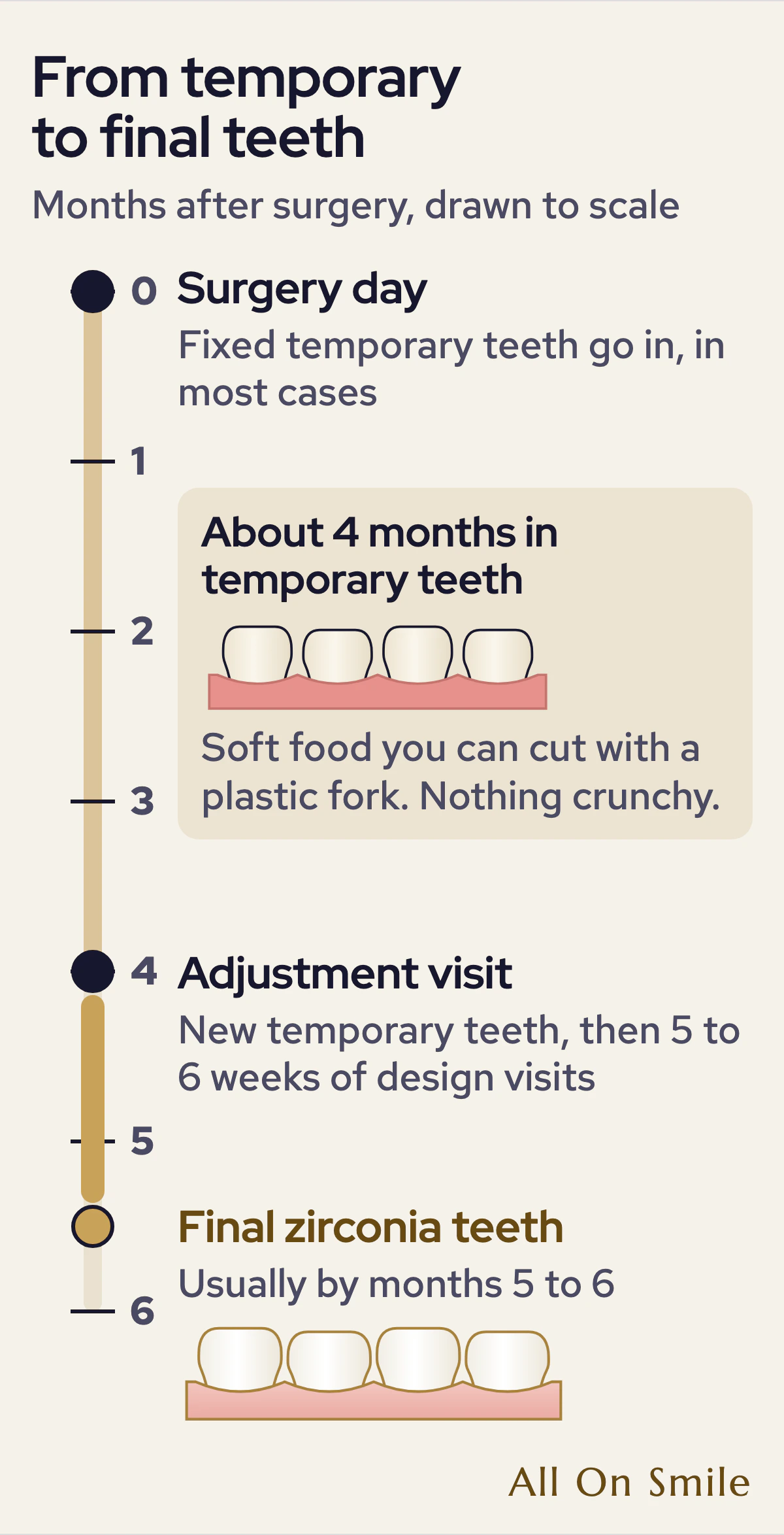
On surgery day, Dr. Ngo removes any remaining teeth, places four to six implants and attaches your fixed temporary teeth, so in most cases you go home with teeth the same day. Over the next months the implants bond with your bone and your gums heal and change shape. The first set needs to be a material that can be adjusted and remade quickly while that happens, and because ours are made in our office, adjustments are quick.
Temporary teeth are strong enough for soft food, not for crunching. In a small 2024 study of 17 milled acrylic temporary bridges, 3 broke completely within a year. A 2026 study of 114 patients found that when a temporary bridge broke during healing, the implants under it were more likely to fail. That is why we ask you to eat soft food you can cut with a plastic fork, skip anything crunchy for the first 4 months, and call us if your temporary teeth ever crack or feel loose. Our implant diet guide has meal ideas.
After about 4 months of healing, we see you for an adjustment visit with new photos, a new 3D scan and a new set of temporary teeth. The steps for your final teeth begin around month 4: over a few visits across 5 to 6 weeks, we design your final zirconia teeth with you, and most people have them by months 5 to 6 after surgery. Our patient guide walks through each of these visits.
How the two compare
Strength and wear
Acrylic is softer than zirconia. Over the years it wears down with chewing, and denture teeth can crack or come loose from the pink base. Zirconia is much harder and resists cracking, chipping and everyday wear. In a study of full-arch bridges followed for up to 12 years, wear was recorded at a yearly rate of 19.4 percent on bridges with acrylic teeth, against 7.3 percent on bridges with porcelain teeth.
Stains, smell and cleaning
Acrylic picks up stains from coffee, tea and red wine over time. Zirconia is smooth and non-porous, so it stays cleaner and resists stains and odors. Because it is so strong, a zirconia bridge can also be slimmer and less bulky, and a low-profile bridge is more comfortable and helps with clear speech.
Weight and feel
Zirconia is heavier than acrylic, and some people notice that at first. It passes after a short while. With your final teeth in, you can enjoy your favorite foods again, even apples, steak and corn.
Repairs and cost
Acrylic is easy to adjust and repair, which is exactly why it suits the healing months. A chip in zirconia is harder to fix, so the habits that protect it matter. Zirconia also costs more to make. On our All-on-4 page, one price covers the fixed temporary teeth and the final zirconia teeth, so there is no separate upgrade to choose.
What the research says about zirconia vs acrylic
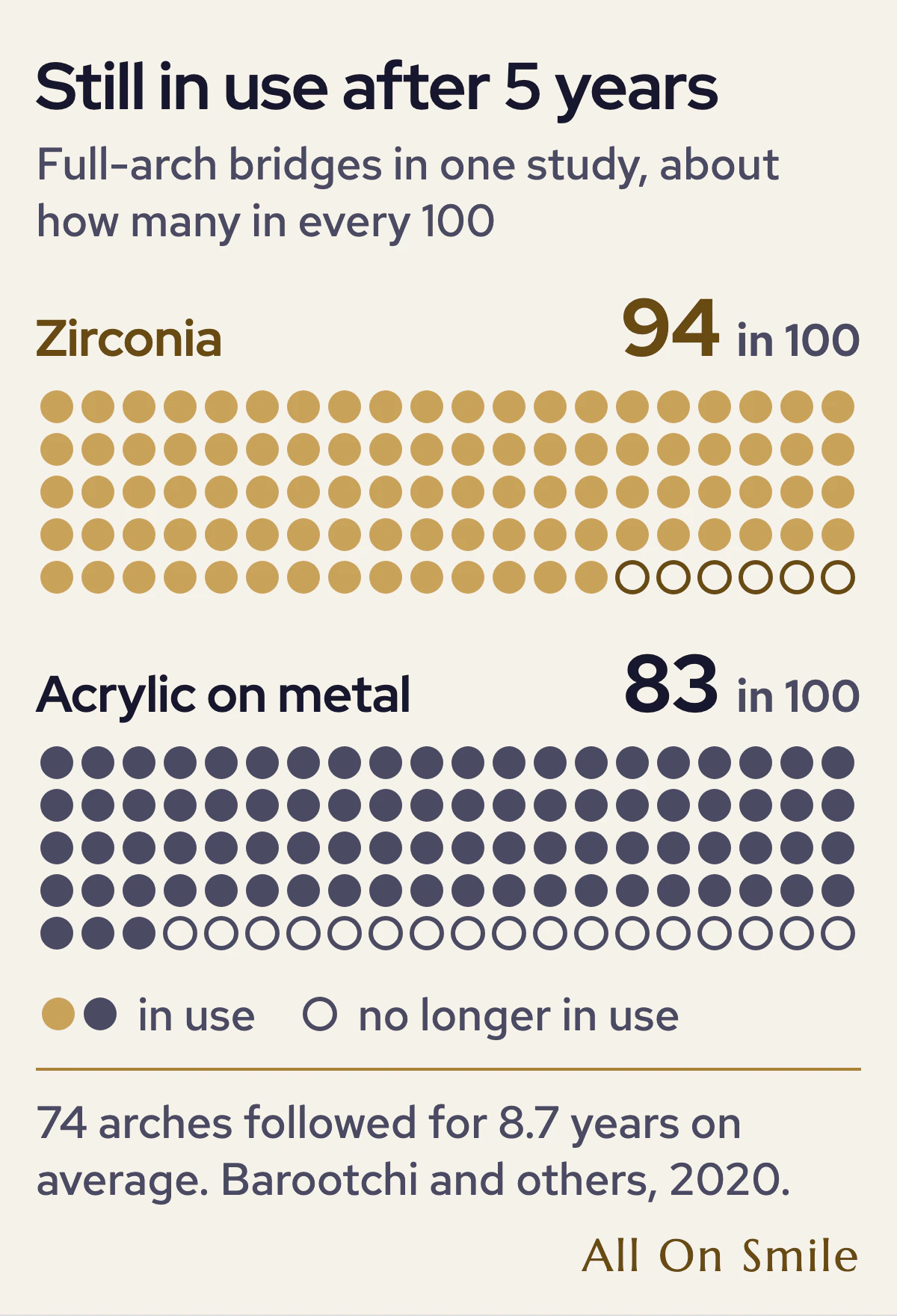
The longest side-by-side comparison so far followed 74 full-arch bridges for 8.7 years on average, 43 acrylic on metal and 31 zirconia. Five years in, about 94 in 100 zirconia bridges were still in use, against about 83 in 100 acrylic ones. Chipped or broken teeth were the most common problem in both groups, and the acrylic bridges had more problems as the years went on. Implant failure and gum disease around the implants were about the same. The zirconia bridges cost more at the start, but because they needed fewer repairs, upkeep costs ended up close.
A 2026 review that pooled 12 studies found less wear and a lower risk of peri-implantitis with zirconia teeth than with acrylic teeth. Most of those studies were not randomized, so the authors call for longer trials.
Zirconia is not unbreakable. A review of 285 zirconia full-arch bridges found 4 that fractured in short-term follow-up, and most smaller problems were chips in porcelain layered on top of the zirconia. In the 12-year study above, grinding at night and not wearing a night guard were linked to more chipping.
Where acrylic fits
Acrylic has a real place. It is the right material for temporary teeth, because it can be adjusted while you heal. At other offices it is also used for final bridges as a lower-cost option, and some people choose it knowing it is more likely to need worn teeth replaced or a new bridge over the years.
If a fixed bridge is not right for you, snap-in dentures are a different option: they are held by implants but come out for cleaning. Our comparison of snap-in dentures and All-on-4 explains how they differ. If you grind your teeth, tell us at your consult, because a night guard matters even more for you.
Caring for zirconia
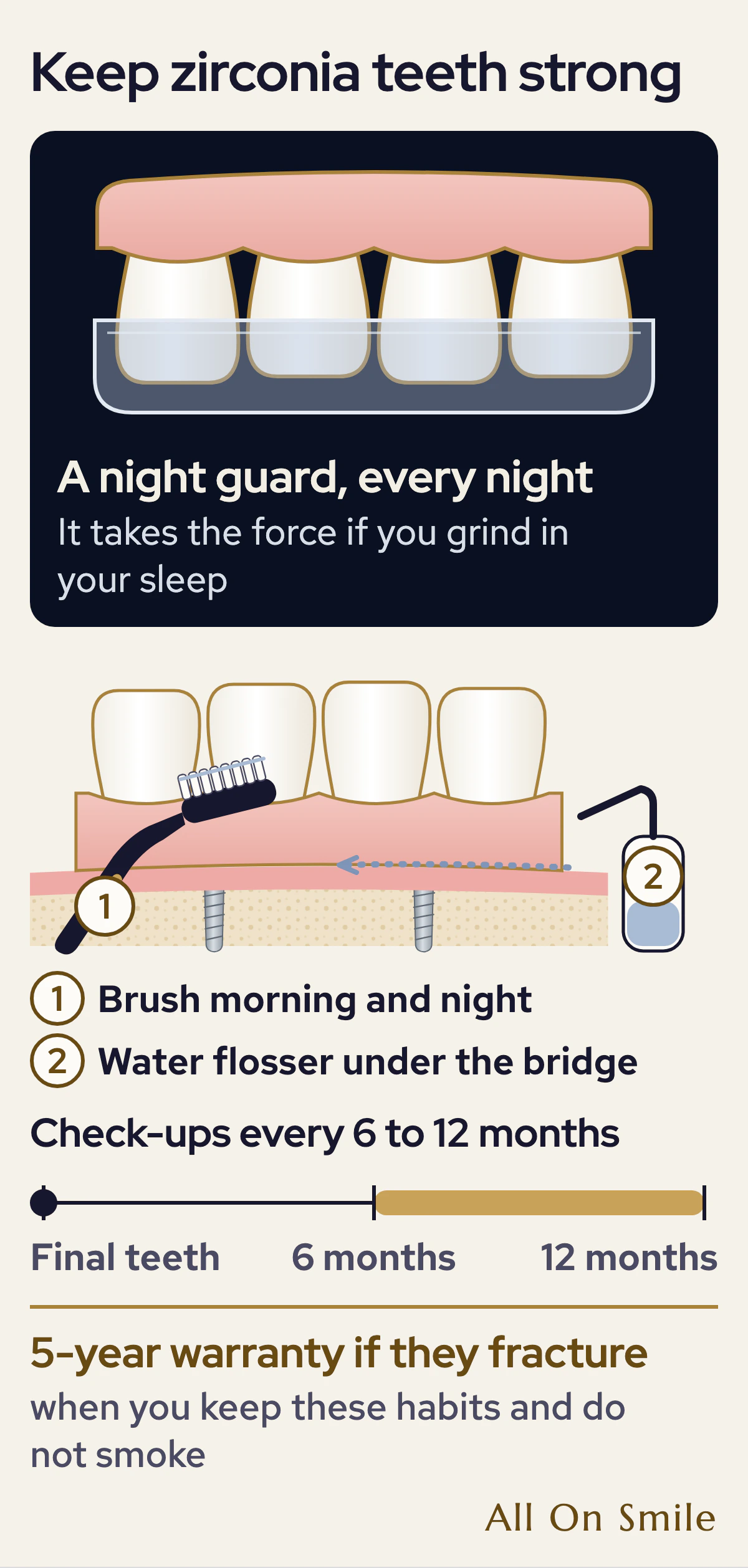
Zirconia resists stains, but plaque still sticks to it, and the gum under the bridge needs cleaning every day. Brush your new teeth morning and night, use a water flosser between your gums and the bridge, and wear your night guard every night. Your first check-up is 6 to 12 months after your final teeth, then every 6 to 12 months, and the bridge only comes off if Dr. Ngo needs to clean or check underneath it. Our guide on how to clean dental implants shows the full routine.
Your final zirconia teeth have a 5-year warranty if they fracture. It holds as long as you brush and floss every day, come in for your regular maintenance visits, do not smoke, and wear your night guard every night. The check-up page of our patient guide has the details.
Common questions about zirconia vs acrylic teeth
Is zirconia better than acrylic for All-on-4?
For final teeth, the studies so far favor zirconia: fewer problems, less wear and more bridges still in use after five years. Acrylic is the better material for temporary teeth, because it can be adjusted while you heal. That is why most people wear both, in that order.
Can zirconia chip or break?
They can, but it is uncommon. Most chips reported in studies were in porcelain layered over the zirconia, and grinding without a night guard raises the risk. Wear your night guard every night and keep your check-ups.
Why start with temporary teeth?
Your implants need about 4 months to bond with your bone, and your gums change shape as they heal. Temporary teeth let you eat soft food and smile the whole time, and they can be adjusted as you heal. Your final zirconia teeth are designed once that healing is done.
Will zirconia teeth feel heavy?
Zirconia is heavier than acrylic, and some people notice it at first. That passes after a short while, and the slim, low-profile shape helps with comfort and clear speech.
Is zirconia included in the All-on-4 price?
Yes. Our All-on-4 price covers extractions, implants, bone grafting if needed, oral sedation, the fixed temporary teeth and the final zirconia teeth.
Zirconia vs acrylic: ask us at a free consult in Vancouver, WA
At your free consultation, Dr. Ken Ngo, DMD, FICOI, reviews your 3D CBCT scan and tells you plainly whether All-on-4 is right for you, with a clear cost breakdown. If you are comparing dental implants in Vancouver, WA, your consultation is free.
Call (360) 844-2170 or book an appointment. We are open Monday through Thursday, 9am to 4pm, at 12503 SE Mill Plain Blvd Suite #222, Vancouver WA 98684.