


A dental implant cannot get a cavity, but the gum and bone around it can still get sick. Peri-implantitis is an infection and inflammation of the tissues around an implant that slowly eats away the bone holding it in place. Left alone, it can loosen an implant that had been doing well for years.
The good news is that it starts with an earlier, reversible stage, and most of what prevents it is in your hands. Here is what peri-implantitis is, the signs to watch for, what raises your risk, and how it is treated.
What is peri-implantitis?
An implant is held by bone, and a collar of gum seals around the top of it, much like the gum around a natural tooth. Plaque, the sticky film of bacteria that builds up every day, collects at that seal. If it is not cleaned away, the gum reacts.
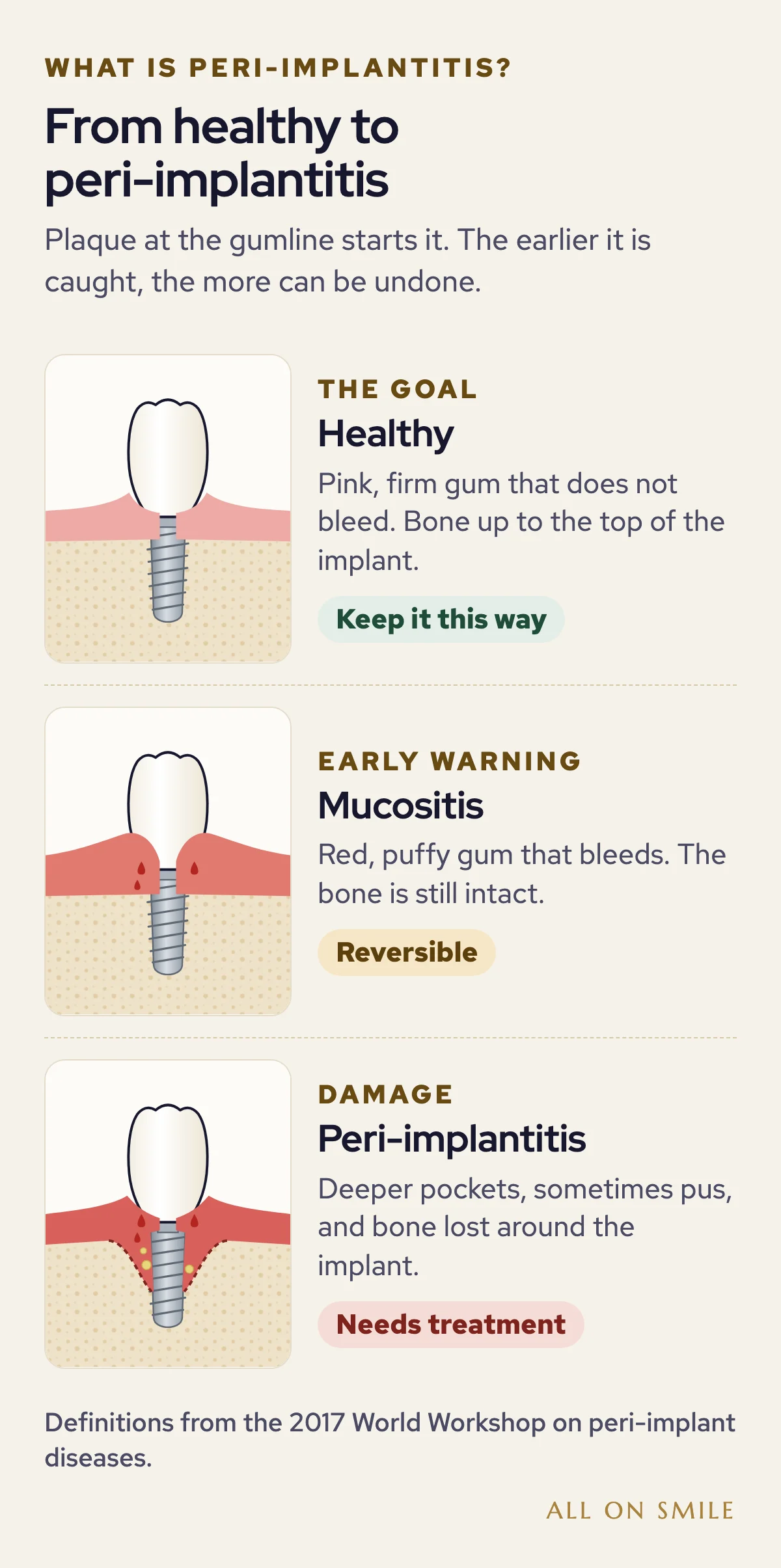
The 2017 World Workshop consensus on peri-implant diseases defines three conditions:
- Healthy. The gum around the implant is pink and firm and does not bleed when it is gently checked.
- Peri-implant mucositis. The gum is inflamed and bleeds, but the bone has not been lost. The consensus found strong evidence that plaque is the cause. It can be reversed.
- Peri-implantitis. The inflammation has spread and the bone around the implant is being lost, which shows on an X-ray. Pockets around the implant get deeper and may release pus.
Think of mucositis as the warning and peri-implantitis as the damage. The same plaque drives both.
Early signs of peri-implantitis
The difficult part is that peri-implantitis often does not hurt, especially early on. Many people only find out at a checkup. These are the signs worth calling about:
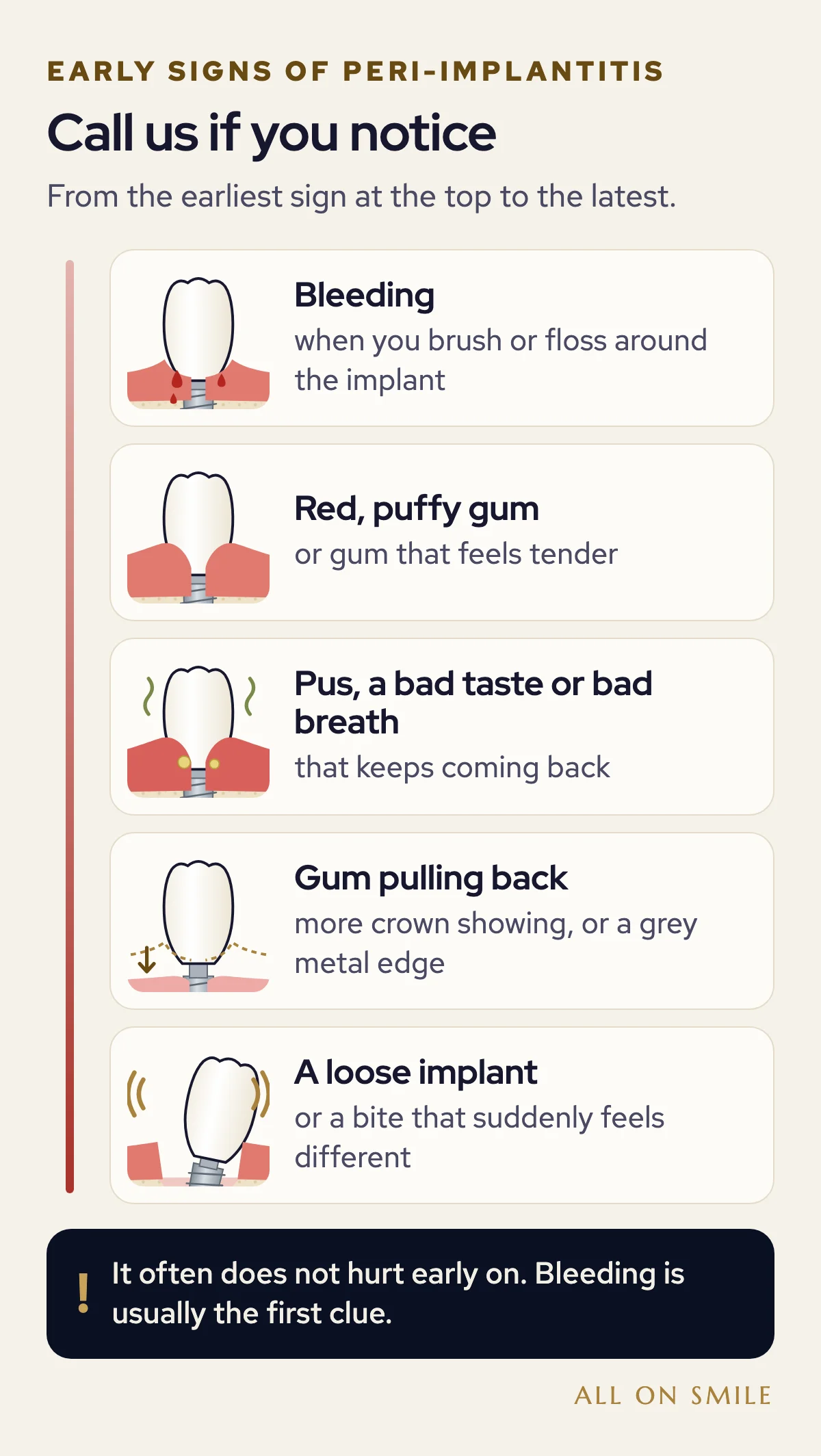
- the gum around an implant bleeds when you brush or floss
- the gum looks red or puffy, or feels tender
- pus, a bad taste, or bad breath that keeps coming back
- the gum is pulling back and you can see more of the crown, or a grey metal edge
- the implant or the teeth on it feel loose, or your bite feels different
Bleeding is the earliest and most common sign. A loose implant is a late sign, and by then much of the bone may be gone. If you notice any of these, call the office rather than waiting for your next visit.
What causes it and who is at risk
Plaque is the starting point. A 2018 review for the same World Workshop found strong evidence that three things raise the risk:
- A history of gum disease (periodontitis). People who lost teeth to gum disease carry a higher risk around their implants too.
- Difficulty cleaning well around the implant, day to day.
- No regular maintenance visits after the implant is finished.
The review found more limited evidence for a few other factors: leftover cement under the gum after a crown is cemented, little firm gum around the implant, and an implant or crown in a position that is hard to clean. Smoking and diabetes are often blamed, and both affect how the mouth heals, but the review found the data linking them to peri-implantitis specifically to be inconclusive.
The same review found that peri-implantitis can start within the first few years and tends to speed up once it begins, rather than moving at a steady pace. That is why the first years of checkups matter.
How common is it?
It is more common than most patients expect. A 2017 analysis of 47 studies in the Journal of Dentistry, all with at least three years of follow-up, estimated that about 1 in 5 patients (20 percent) and about 1 in 11 implants (9 percent) had peri-implantitis. The earlier stage, mucositis, was found in almost half of patients.
The numbers vary a lot between studies, because they define the disease differently, and a 2015 systematic review found that it becomes more common the longer implants have been in place. None of this means implants are fragile. Most implants last for decades, as our article on how long dental implants last explains. It means implants need the same kind of care as natural teeth.
How to prevent peri-implantitis
Prevention comes down to two things: cleaning around the implant every day, and having it checked and professionally cleaned on a regular schedule.
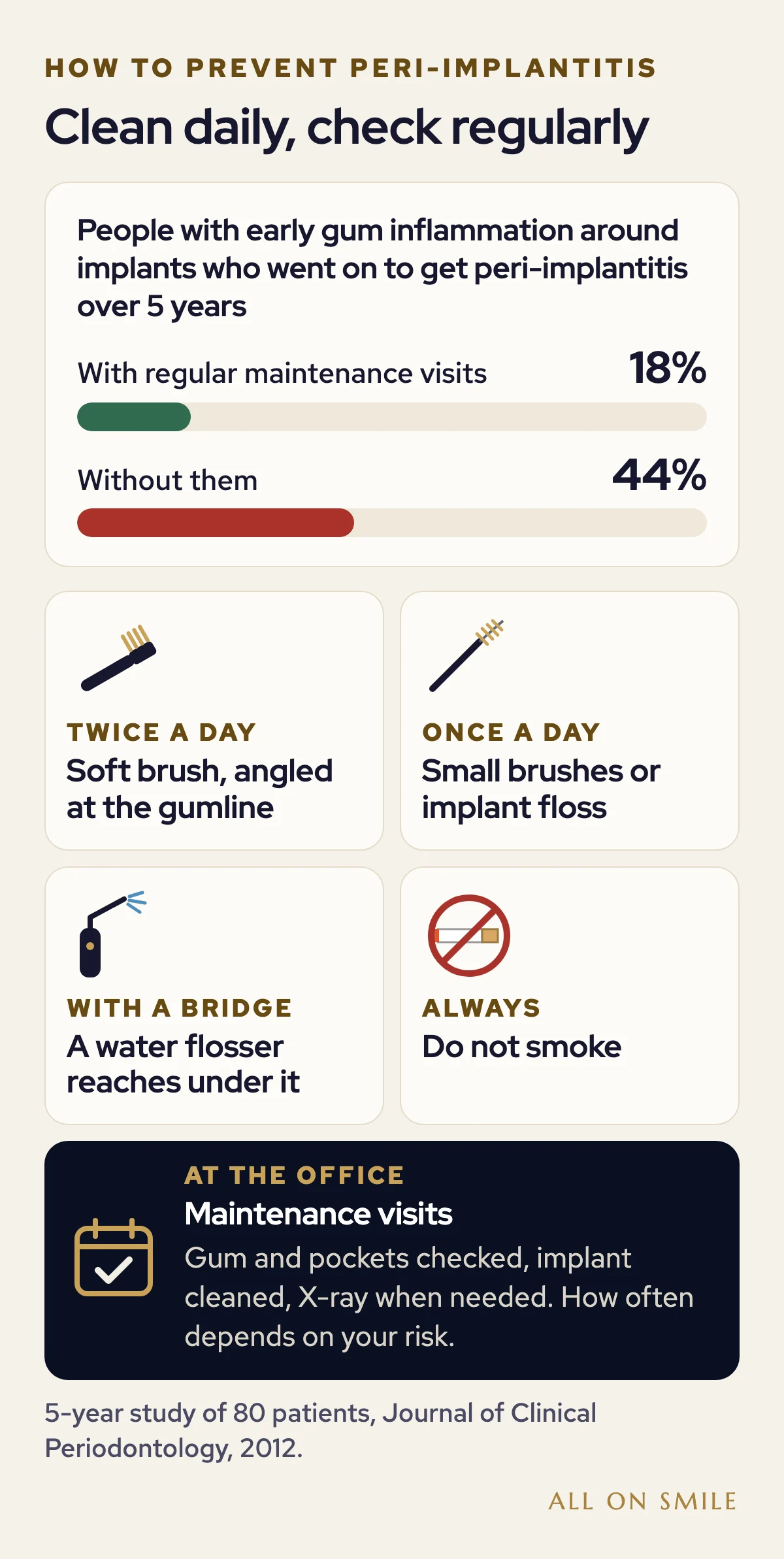
At home, every day:
- brush twice a day with a soft brush, angled toward the gumline around each implant
- clean between and around implants once a day with small interdental brushes, implant floss or a water flosser, whichever you will actually use
- under a fixed full-arch bridge, a water flosser or threader floss reaches the space between the bridge and the gum, where a toothbrush cannot
- do not smoke
At the office: regular maintenance visits, where the gum around each implant is checked for bleeding and pocket depth, the implant is cleaned with instruments that will not scratch it, and an X-ray, when needed, shows whether the bone level around the implant has changed.
The research on maintenance is clear. A 5-year study in the Journal of Clinical Periodontology followed 80 people who already had mucositis. Among those who kept up regular maintenance visits, 18 percent developed peri-implantitis. Among those who did not, 44 percent did.
How often you should come in depends on your own risk. A 2016 review of maintenance studies suggested a recall interval of about 5 to 6 months as a reasonable minimum, and people with a history of gum disease may need visits more often. Dr. Ngo will tell you which schedule fits your mouth.
At All On Smile, our lifetime warranty on dental implants depends on the same habits: it applies as long as you follow our office hygiene protocol, such as daily home care, a yearly office maintenance visit and not smoking. Ask our office for the details.
How peri-implantitis is treated
Treatment depends on the stage, which is why catching it early makes such a difference.
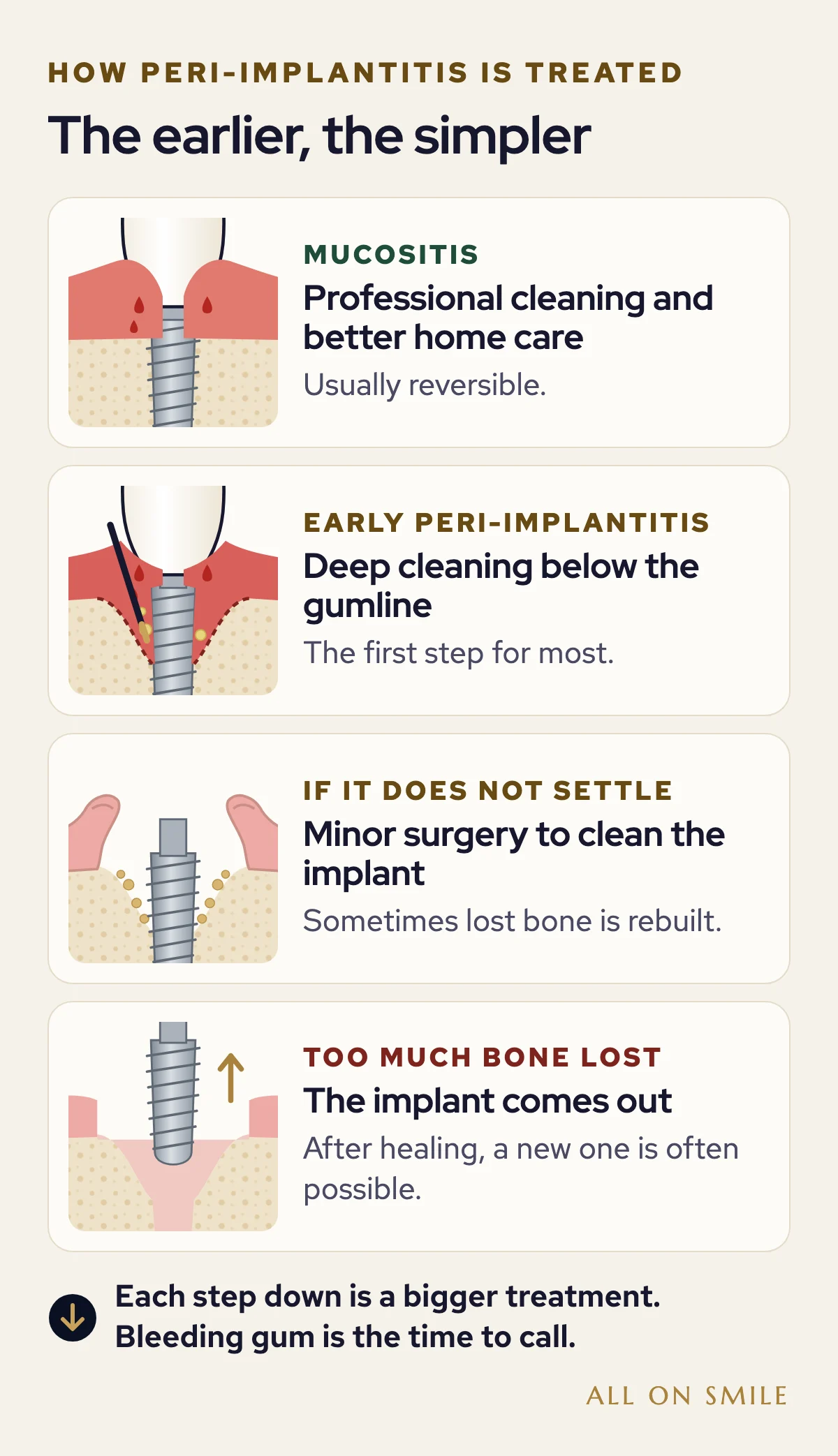
Mucositis is usually treated with a professional cleaning around the implant and better home care. In a 2012 study, volunteers with implants stopped cleaning one area for three weeks. The gum around their implants became inflamed, more strongly than around their natural teeth. Once they started cleaning again, the inflammation went back down, although three weeks was not quite long enough to return fully to where they started.
Peri-implantitis needs more. Treatment usually starts with a deep cleaning around the implant below the gumline. If the inflammation does not settle, a minor surgery may be needed to open the gum, clean the implant surface directly and, in some cases, rebuild part of the lost bone. When too much bone is gone, removing the implant can be the healthiest choice. After healing, a new implant is often possible, sometimes with a bone graft first. Our article on dental implants with bone loss explains how that works.
The 2023 clinical practice guideline from the European Federation of Periodontology describes peri-implantitis as particularly challenging to manage. It recommends prevention from the moment implants are planned and a structured program of supportive care once they are in use, with regular checks of the tissue around them.
Peri-implantitis with All-on-4 and other full-arch teeth
People who get a full arch of new teeth often lost their own teeth to gum disease, so they start with the higher-risk history. A fixed bridge also has a space underneath it, against the gum, that a toothbrush does not reach.
That does not make All-on-4 dental implants a poor choice. It means the cleaning routine and the maintenance visits are part of the treatment. At those visits the bridge can be taken off when needed so the implants underneath can be checked and cleaned. If you prefer teeth you can take out and clean by hand, snap-in implant dentures are worth comparing. Our guide to what All-on-4 is covers how the bridge is made and fixed.
Is peri-implantitis the same as implant failure?
Not exactly. Some implants fail early because the bone never bonds to them during healing. Peri-implantitis is different: it affects an implant that had bonded well, often years later. Our article on the dental implant failure rate covers both kinds, and the implant recovery guide explains how to look after the gum in the first weeks.
If you are still deciding on implants and have had gum disease, it is worth raising at your consultation. It does not usually rule you out, but it shapes the plan. See am I a candidate for dental implants.
Common questions about peri-implantitis
Can peri-implantitis be cured?
The early stage, mucositis, can usually be reversed with cleaning and better home care. Peri-implantitis can often be stopped and the area kept stable with treatment and regular maintenance, but bone that has already been lost does not always grow back, so it is managed rather than simply cured.
Does peri-implantitis hurt?
Often not, especially early. Bleeding when you brush is usually the first sign. Pain, swelling or a loose implant tend to come later, which is why regular checkups matter even when everything feels fine.
Can you get peri-implantitis years after getting an implant?
Yes. It can start in the first few years or much later, and it becomes more common the longer implants are in place. Keeping up home care and maintenance visits for life is the best protection.
Should I use a water flosser on my implants?
A water flosser is a good choice for many people with implants, especially under a fixed bridge. Small interdental brushes and implant floss also work well. The best tool is the one you will use every day, and we can show you how.
Is peri-implantitis the same as gum disease?
They are close relatives. Gum disease (periodontitis) affects natural teeth, and peri-implantitis affects implants, but both start with plaque, and a history of gum disease raises the risk of peri-implantitis.
Daily cleaning is the best way to prevent all of this. Our step-by-step guide on how to clean dental implants shows the routine and tools for one implant, a bridge, All-on-4 and snap-in dentures.
Help with peri-implantitis in Vancouver, WA
If the gum around one of your implants is bleeding, swollen or pulling back, it is worth having it checked soon, while it is easier to treat. At All On Smile Implant & Cosmetic Dentistry, Dr. Ken Ngo, DMD, FICOI, uses CBCT 3D imaging to see the bone around an implant, and he will tell you plainly what he finds and what he recommends. If you are planning dental implants in Vancouver, WA, your consultation is free, and the cleaning routine that keeps implants healthy is part of the plan from day one.
Call (360) 844-2170 or book an appointment. We are open Monday through Thursday, 9am to 4pm, at 12503 SE Mill Plain Blvd Suite #222, Vancouver WA 98684.