

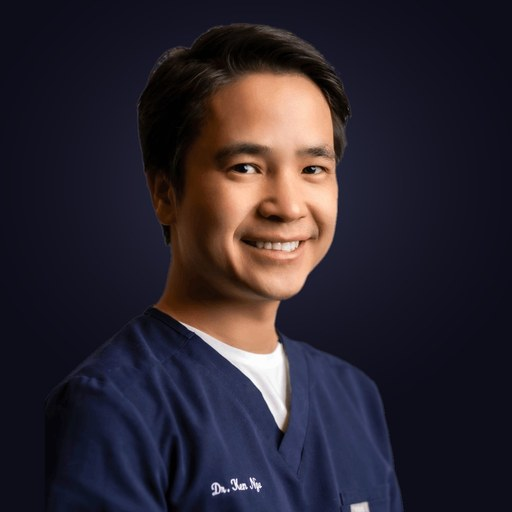
Most people who sit down for a consult with us have been carrying the same dental implant questions for months, sometimes years. Will it hurt? Is there enough bone? How long will I be without teeth? Can I afford it? These are the questions Dr. Ken Ngo hears every week at All On Smile in Vancouver, WA, and below are the answers he gives across the desk, in plain words.
Every mouth is different, so treat this as a starting point. The scan and exam at a free consult turn these general answers into your answers.
1. Am I a candidate if I have bone loss or health problems, or if I am older?
Many people are, including people who have been told they do not have enough bone. Three things decide it: bone, health and age.
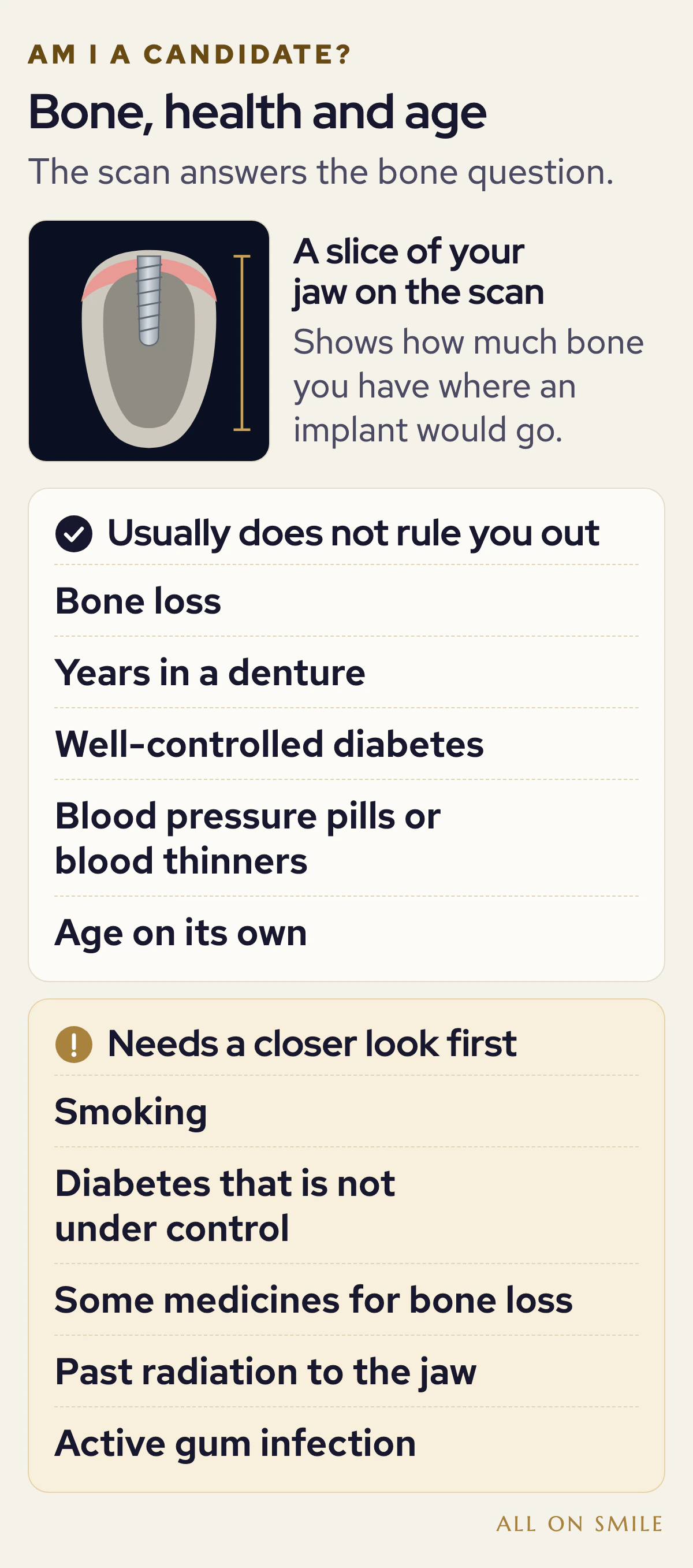
Bone shrinks after teeth are lost or after years in a denture. That makes planning more careful, not impossible. A 3D CBCT scan shows how much bone you have and where it is strongest. Sometimes implants can be angled into that stronger bone; sometimes a bone graft is needed first. Our article on dental implants with bone loss explains both routes.
Your general health matters because implants need to heal into the bone. Well-controlled diabetes, blood pressure medicine or a blood thinner usually do not rule you out, but Dr. Ngo needs your full medical history and medication list, and he may talk with your physician first. Some medicines for bone loss and treatments such as radiation to the jaw need a closer look.
Age on its own is rarely the problem. There is no set upper age limit, and your health counts for more than your birthday. More on that in am I a candidate for dental implants.
2. Does getting implants hurt, and will I be awake?
The area is fully numbed before anything starts, so during treatment you should feel pressure, not pain.
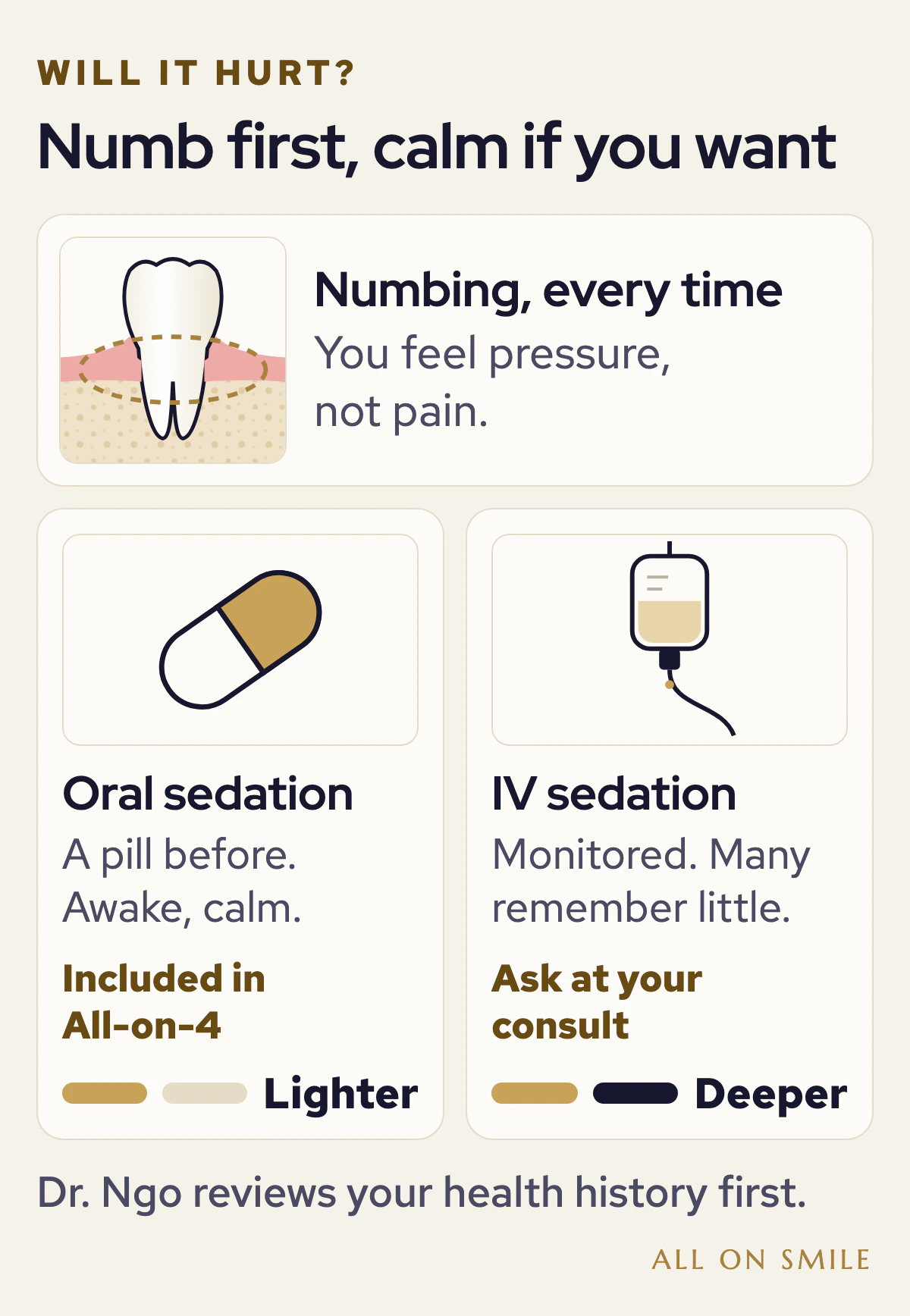
If you are nervous, we offer two levels of sedation:
- Oral sedation is a prescribed medicine you take before the visit. You stay awake but calm, and time seems to pass quickly. Oral sedation is included in All-on-4 treatment.
- IV sedation is deeper and is monitored throughout. Many patients remember little or nothing of the visit afterward.
Dr. Ngo goes over your health history before recommending either one. Afterward, expect some soreness and swelling for a few days. Most people manage it well with the pain plan we give them. See sedation dentistry and the week-by-week implant recovery guide.
3. Which is right for me: one implant, All-on-4 or snap-in dentures?
It depends on how many teeth are missing or failing, and on whether you want teeth that stay in or teeth you take out to clean.
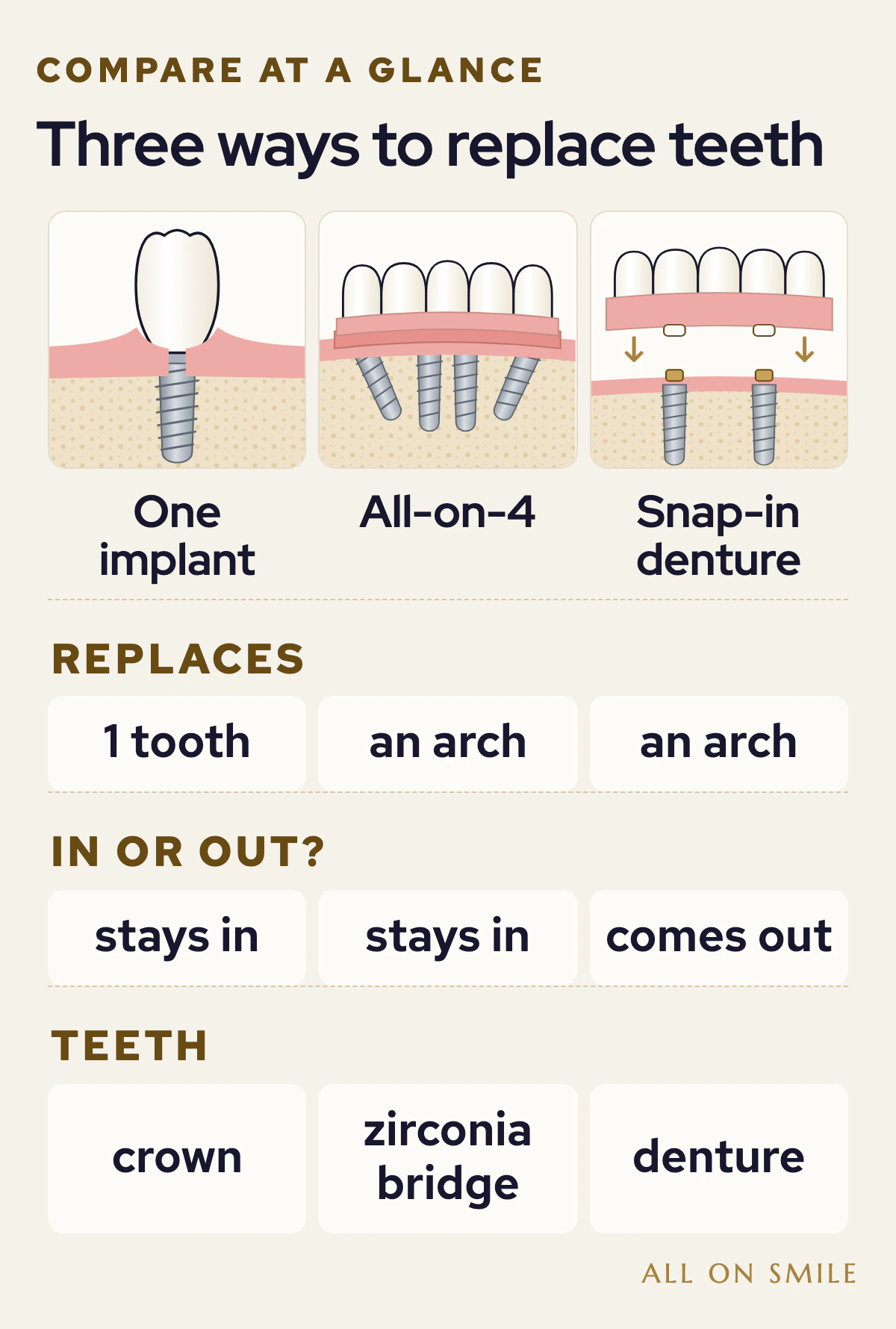
- A single implant replaces one tooth: a titanium post in the bone with a crown on top, matched to the teeth beside it. Nothing is cut down on the neighboring teeth.
- All-on-4 replaces a whole arch with one fixed bridge on four to six implants. You do not take it out; you brush and clean under it every day. The final teeth we make are zirconia.
- Snap-in implant dentures click onto implants and come out for cleaning. They are much steadier than a regular denture, and the denture itself may need repairs or replacing over time from normal wear.
If you are torn between the last two, our comparison of snap-in dentures vs All-on-4 walks through the differences in daily life.
4. Can I leave with teeth the same day?
With All-on-4 dental implants, in most cases, yes. On surgery day any remaining failing teeth are removed, the implants are placed and a fixed temporary bridge is attached before you go home, as long as the implants are stable enough on the day. You start on soft foods while the implants heal.
With a single tooth, it depends. If the implant is stable enough on the day, a temporary crown can sometimes go on at the same visit, which matters most for a front tooth. Our article on immediate dental implants explains when that works and when waiting is safer. With snap-in dentures you wear a denture while the implants heal, and we add soft liners to keep it comfortable.
5. How long does it take to get my final teeth?
Counted from surgery day, most cases take about four to six months to reach the final teeth, with only a handful of visits along the way. The free consult and planning come before that.
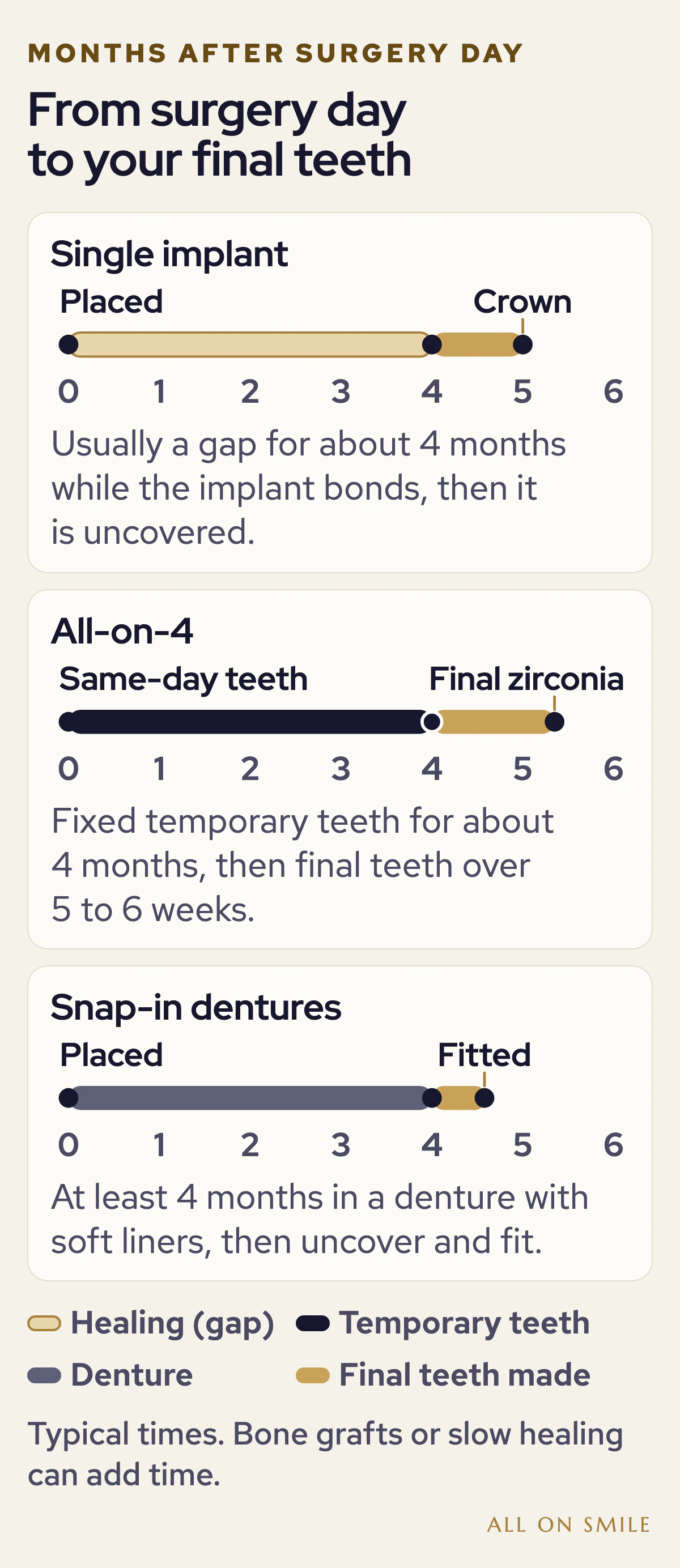
- For a single implant, the implant bonds with the bone for about 4 months. We then uncover it, give the gum about 2 weeks to shape, take digital scans and fit your crown.
- For All-on-4, surgery day takes about 4 to 6 hours. You wear the temporary bridge for about 4 months, then we design and make your final zirconia bridge with you over a few visits across 5 to 6 weeks.
- For snap-in dentures, we check you the day after surgery, then the implants rest under the gum for at least 4 months. After that we uncover them, and at a later visit fit the attachments and your denture, which can usually be done in one day.
Bone grafting, extractions that need extra healing or a slow-healing site can add time. You will know your own timeline before you start.
6. How long do implants last, and what care do they need?
A 2019 review of 18 studies that followed implants for 10 years estimated that about 96 percent were still in place at 10 years. The teeth on top see daily wear and may need repairs or replacing over time. What happens over the years depends a lot on care.
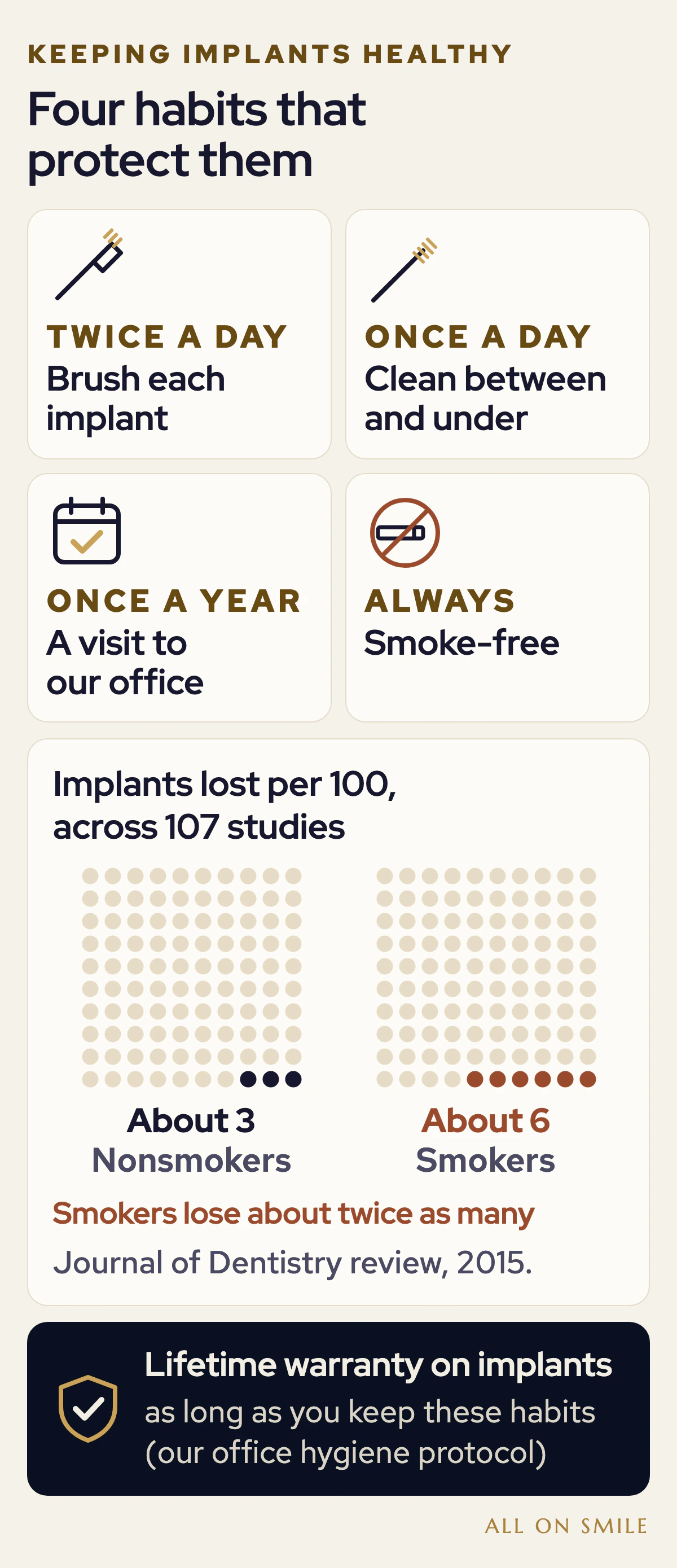
For the daily cleaning, small brushes, implant floss or a water flosser all work; under a fixed bridge a water flosser is often easiest. Smoking matters most: a 2015 review of 107 studies found implants in smokers failed about twice as often as in nonsmokers.
Those habits are also the conditions of our lifetime warranty on all dental implants: it applies as long as you follow our office hygiene protocol, with daily home care, a yearly office maintenance visit and not smoking. Ask our office for the details. If the gum around an implant ever bleeds or swells, call us; our guide to peri-implantitis explains why early checks matter.
7. What does the price include, and how do I pay without insurance?
Our prices are published, and at your consult you get one price for your treatment plan before anything starts.
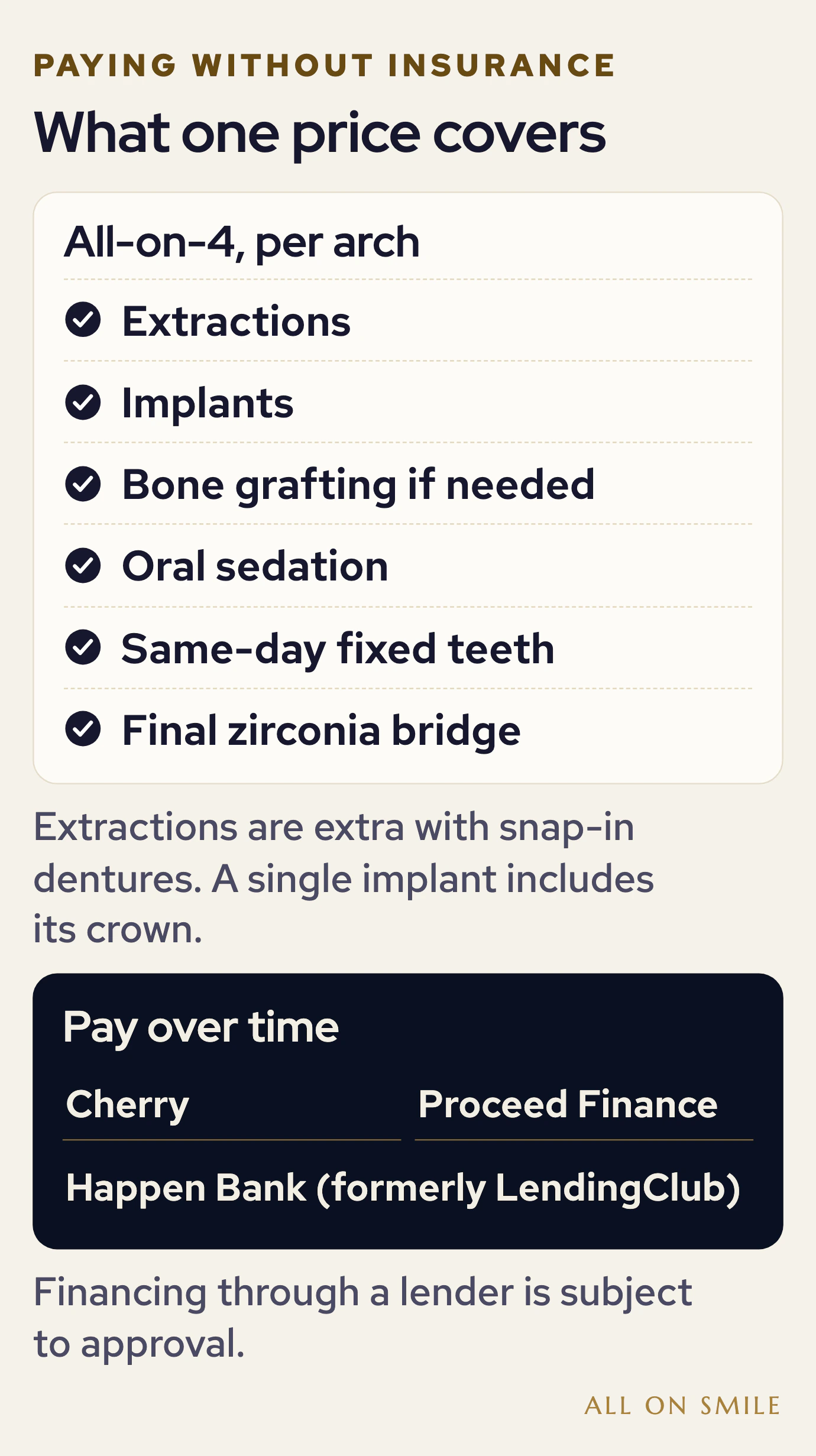
All On Smile does not bill dental insurance. For All-on-4 that is one price per arch; for snap-in dentures, extractions are separate. Our page on dental implants without insurance lists the prices and what each includes.
You do not have to pay all at once. We work with Cherry, Proceed Finance and Happen Bank (formerly LendingClub). Financing through a lender is subject to approval. HSA and FSA funds can generally be used for qualified dental treatment; check your plan’s rules before your visit.
8. What happens at the free consultation?
The consult is free and there is no obligation.
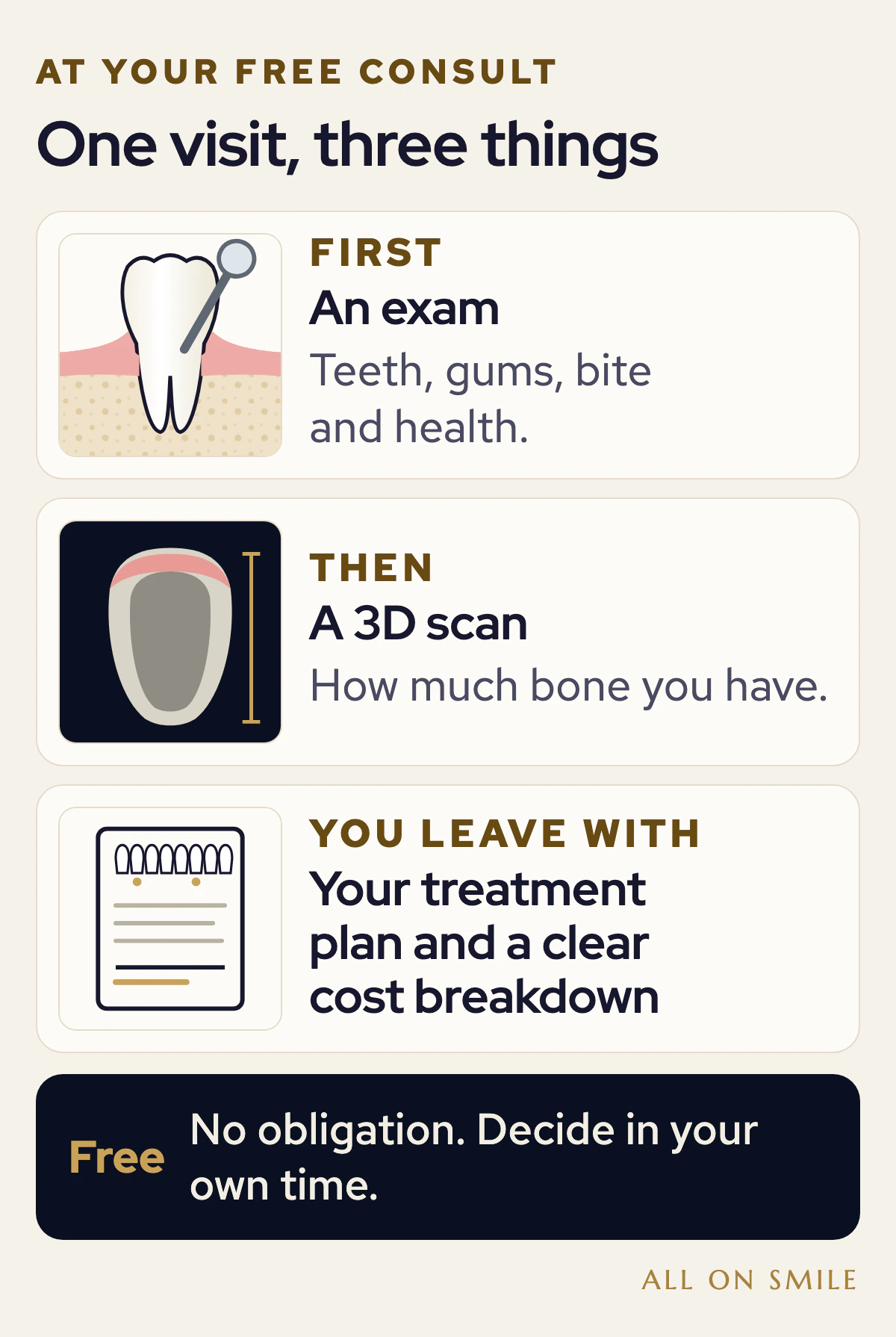
Dr. Ngo examines your mouth and takes a 3D scan, then sits down with you to go through it: where your bone is strong, where it is thin, and which options will actually work in your mouth.
You leave with your treatment plan and a clear cost breakdown. Bring your medication list, your questions and, if you like, your spouse or a friend. Some people book their treatment that day; many go home, talk it over and call back later. Both are completely fine. See what is included in the free consultation.
9. How do I choose who places my implants?
These are fair questions to ask any office, ours included:
- Will the same doctor see me at the consult, place my implants and fit my final teeth?
- Is my treatment planned on a 3D scan?
- Where are my teeth made, and what are the final teeth made of?
- What exactly does the price include, in writing?
- What training does the doctor have in implant surgery and in the teeth that go on top?
- What happens if something needs fixing later, and what are the warranty terms?
At All On Smile the answers are short. Dr. Ken Ngo, DMD, a Fellow of the International Congress of Oral Implantologists (FICOI), sees you at the consult, places your implants and cares for you through your final teeth. Implants and full-mouth treatment are most of what he does, and our digital design and milling team works on site. Our lifetime warranty and its conditions (daily home care, a yearly office maintenance visit and not smoking) are in question 6 above. More in our guide to choosing a dental implant dentist.
10. What happens if I decide to wait?
Waiting is your call. It helps to know what time does: after a tooth is lost, the bone under it slowly shrinks, and the teeth beside the gap can drift and tilt. Waiting rarely makes treatment simpler, so if you are not ready yet, a consult still tells you where you stand today. Our article on what happens if you don’t replace a missing tooth covers it in detail.
Quick answers to a few more questions
What are dental implants made of?
The implant itself is a small titanium post that bonds with your jawbone. On top goes a crown, a bridge or a denture. For All-on-4, the final bridge we make is solid zirconia.
Will people be able to tell I have implants?
Usually not. Crowns and bridges are designed to match your face and the teeth you have left, and for All-on-4 you help design the final teeth with Dr. Ngo and our technician.
How much time off work will I need?
Many people take a few days off after surgery, more after a full arch than after a single implant. Soreness and swelling are usually worst in the first few days.
Can I eat normally with implants?
Once healing is done and the final teeth are in, most people eat a normal diet. During healing you start on soft foods and add firmer foods as the implants bond with the bone.
Will implants feel like my own teeth?
A single implant or a fixed All-on-4 bridge is anchored in bone, so it does not rest on your gums or lean on other teeth, and it feels solid when you bite. Snap-in dentures are much steadier than a regular denture, though they still rest partly on the gums.
Bring your dental implant questions to a free consult in Vancouver, WA
The quickest way to get answers about your own mouth is a free consult with a 3D scan. If you are considering dental implants in Vancouver, WA, bring your questions, and Dr. Ngo will go through your options with you without pressure.
Call (360) 844-2170 or book an appointment. We are open Monday through Thursday, 9am to 4pm, at 12503 SE Mill Plain Blvd Suite #222, Vancouver, WA 98684.