


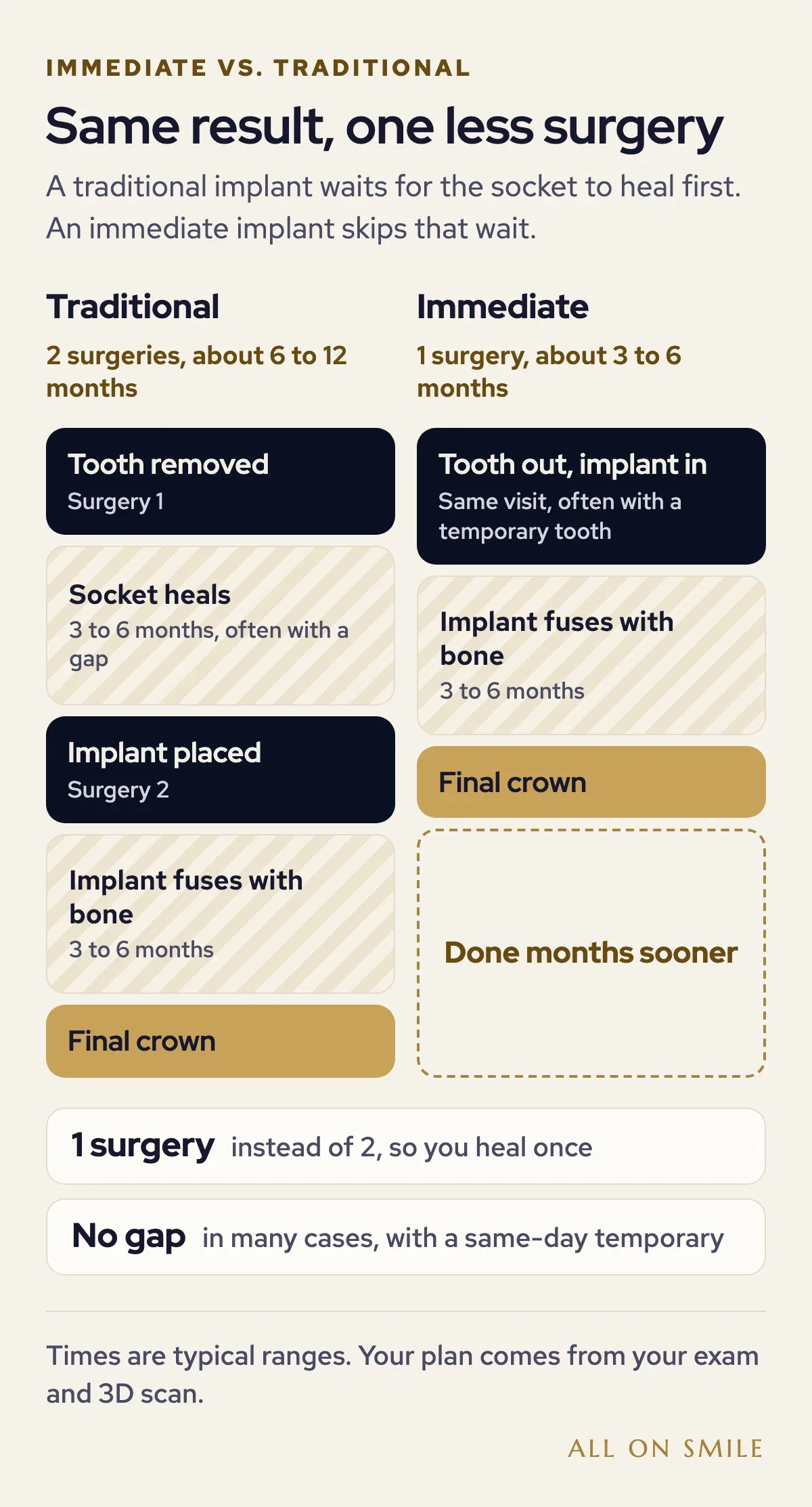
An immediate dental implant goes in the same visit your tooth comes out, often with a temporary tooth attached before you leave. It saves the usual wait: a gap, a long healing period, then a second surgery. In Vancouver, WA, Dr. Ken Ngo offers it when the bone and gum around the tooth allow it.
It is one of the most useful options in implant dentistry, and one of the most misunderstood. Here is how it works, who it suits, and when waiting is actually the better plan.
What are immediate dental implants?
An immediate dental implant is placed directly into the socket right after a tooth is extracted. Instead of letting the site heal for several months first, the implant goes in while you are already numb and the area is already open.
Dentists group implant timing into a few categories:
- Immediate placement: the implant goes in the same day as the extraction.
- Early placement: the implant goes in a few weeks to a few months after the extraction, once the gum and some of the bone have healed.
- Delayed placement: the site heals fully, often with a bone graft, and the implant is placed months later.
None of these is the best choice in every case. The right timing depends on the bone and gum around the tooth you are losing.
Immediate placement vs. immediate loading
These two terms get mixed up a lot. Immediate placement is about when the implant goes into the bone. Immediate loading is about when a tooth is attached to it.
For a single front tooth, we can often place the implant and attach a temporary crown the same day, so you never walk around with a gap. That temporary is shaped to sit slightly out of your bite while the implant fuses with the bone. For a back tooth, the implant may go in the same day with a small healing cap instead, because chewing forces there are much higher.
When a whole arch of teeth is being replaced, the same idea scales up into same-day teeth with All-on-4. This article focuses on single teeth and small groups of teeth.
How the procedure works
1. Planning with 3D imaging
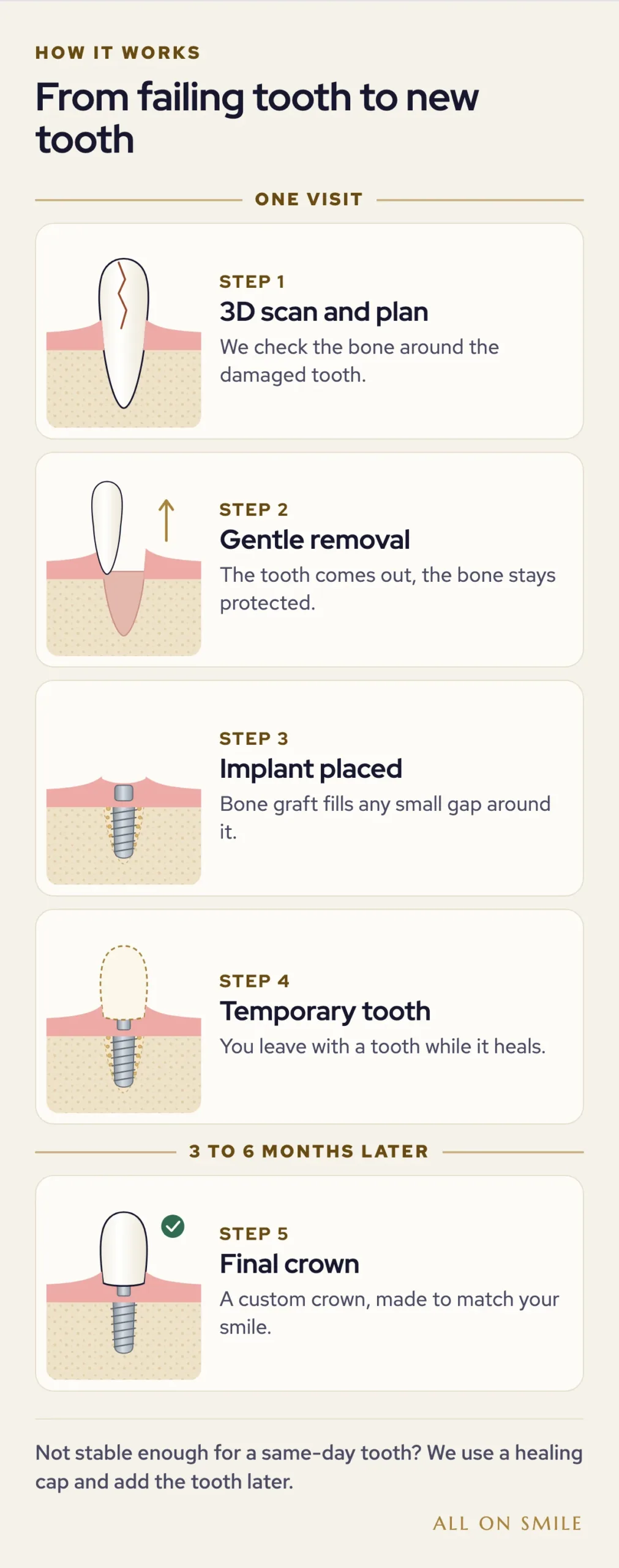
Before anything is removed, we take a CBCT 3D scan. It shows the thickness of the bone around the root, the condition of the outer wall of the socket, the position of nerves and sinuses, and how much bone sits beyond the tip of the root. That last part matters most, because the implant needs firm bone to anchor into on day one.
2. A gentle extraction
The tooth is removed as gently as possible to protect the thin wall of bone around it, especially on the cheek side. A careful extraction is half of a successful immediate implant.
3. Placing the implant
The implant is positioned in the socket and anchored into the bone past the old root. Any small space between the implant and the socket wall is usually filled with bone graft material to support the bone and the shape of the gum.
4. A temporary tooth or a healing cap
If the implant is stable enough, a temporary crown can be made the same day. Our intraoral scanner and on-site lab make that practical in a single visit. If stability is not quite where it needs to be, we place a healing cap and let the implant settle first. That decision is made in the chair based on how the implant actually feels, and it is the right call either way.
5. Healing, then the final crown
Over the next three to six months, the implant fuses with the bone. Once it is fully integrated, we scan for and place your final custom crown.
Benefits of immediate dental implants
- Fewer surgeries. One procedure handles both the extraction and the implant, instead of two appointments with months of healing in between.
- A shorter overall timeline. Skipping the socket healing stage can take several months off your total treatment time.
- No gap, in many cases. When a same-day temporary is possible, nobody has to know you lost a tooth.
- A more natural gumline. Supporting the gum right away with the implant and a well-shaped temporary helps preserve the look of the gums around front teeth.
- One recovery. You heal once instead of twice.
Who is a good candidate?
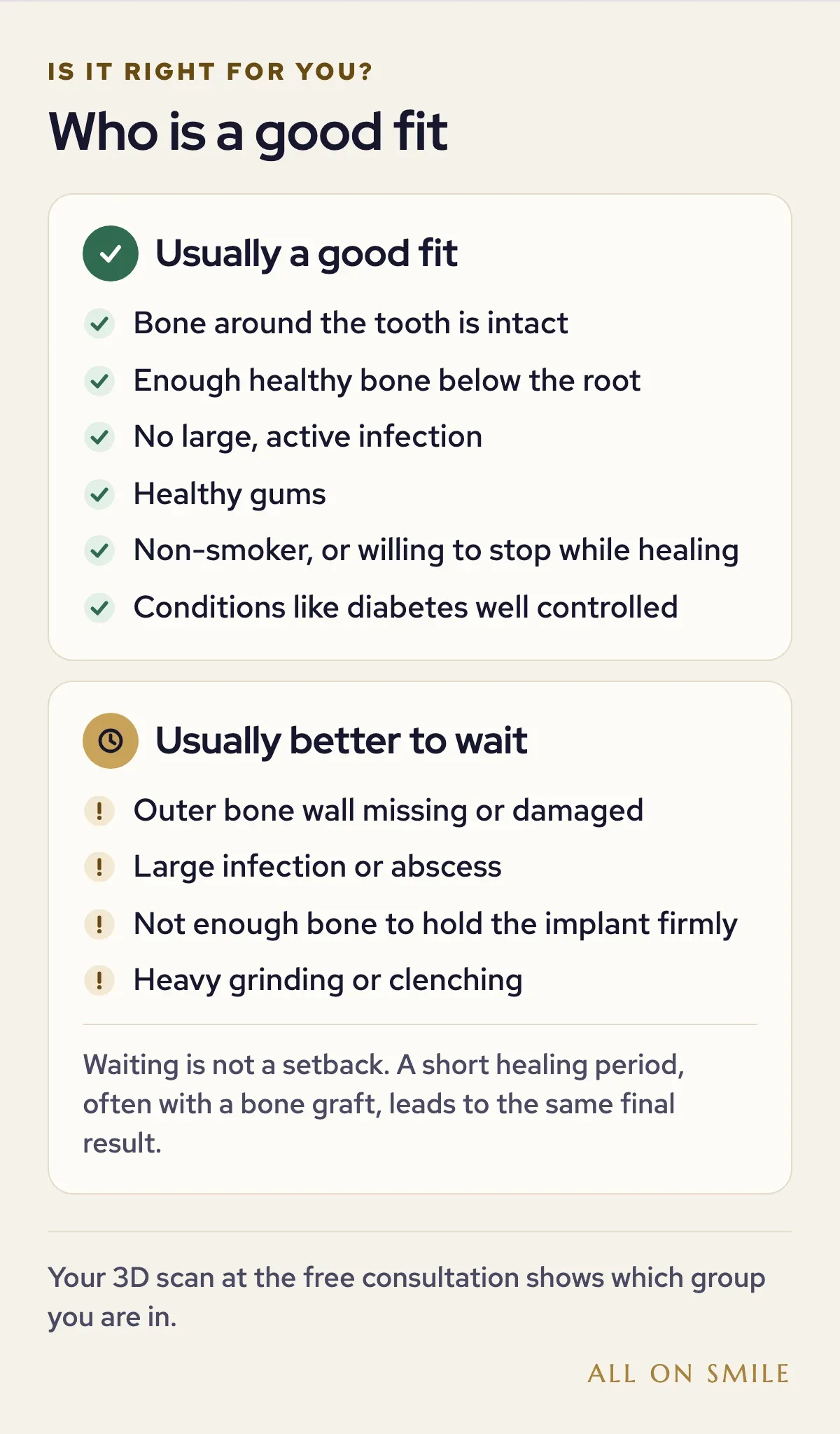
Immediate implants tend to work best when:
- the bone walls around the tooth are intact, especially the thin outer wall
- there is enough healthy bone beyond the root tip to hold the implant firmly
- there is no large, active infection at the site
- the gums are healthy
- you do not smoke, or are willing to stop while you heal
- medical conditions such as diabetes are well controlled
Teeth that often fit this picture include a cracked or fractured tooth, a tooth with a failed root canal, a tooth with decay too deep to restore, and a baby tooth that never had an adult tooth underneath it. If you are not sure where you stand, our guide on whether you are a candidate for dental implants is a good place to start.
When waiting is the better choice
Honest implant dentistry means saying no to same-day placement when it is the wrong fit. We usually recommend waiting, often with a bone graft first, when:
- the outer wall of bone is missing or badly damaged
- there is a large infection or abscess that needs to clear
- there is not enough bone to anchor the implant firmly
- heavy grinding or clenching would put a fresh implant at risk
Waiting a few months is not a setback. Implants placed in healed or grafted bone have an excellent track record, and patients on that path end up with the same final result. If bone loss is part of your situation, our article on dental implants with bone loss explains what grafting involves.
How successful are immediate dental implants?
In carefully selected patients, the research is reassuring. A 2022 review of 53 clinical studies in Clinical Oral Implants Research found that immediate implants had a survival rate of about 97 percent, with no significant difference from implants placed in healed bone. The important words are carefully selected. Most problems with immediate implants trace back to placing them in sites that were not suitable to begin with.
In the front of the mouth, the bigger risk is usually not the implant failing. It is the gumline shrinking slightly over time. That is why the 3D scan, the gentle extraction, and grafting the gap matter so much. For more on what affects long-term success, read what patients should know about implant failure rates.
What recovery feels like
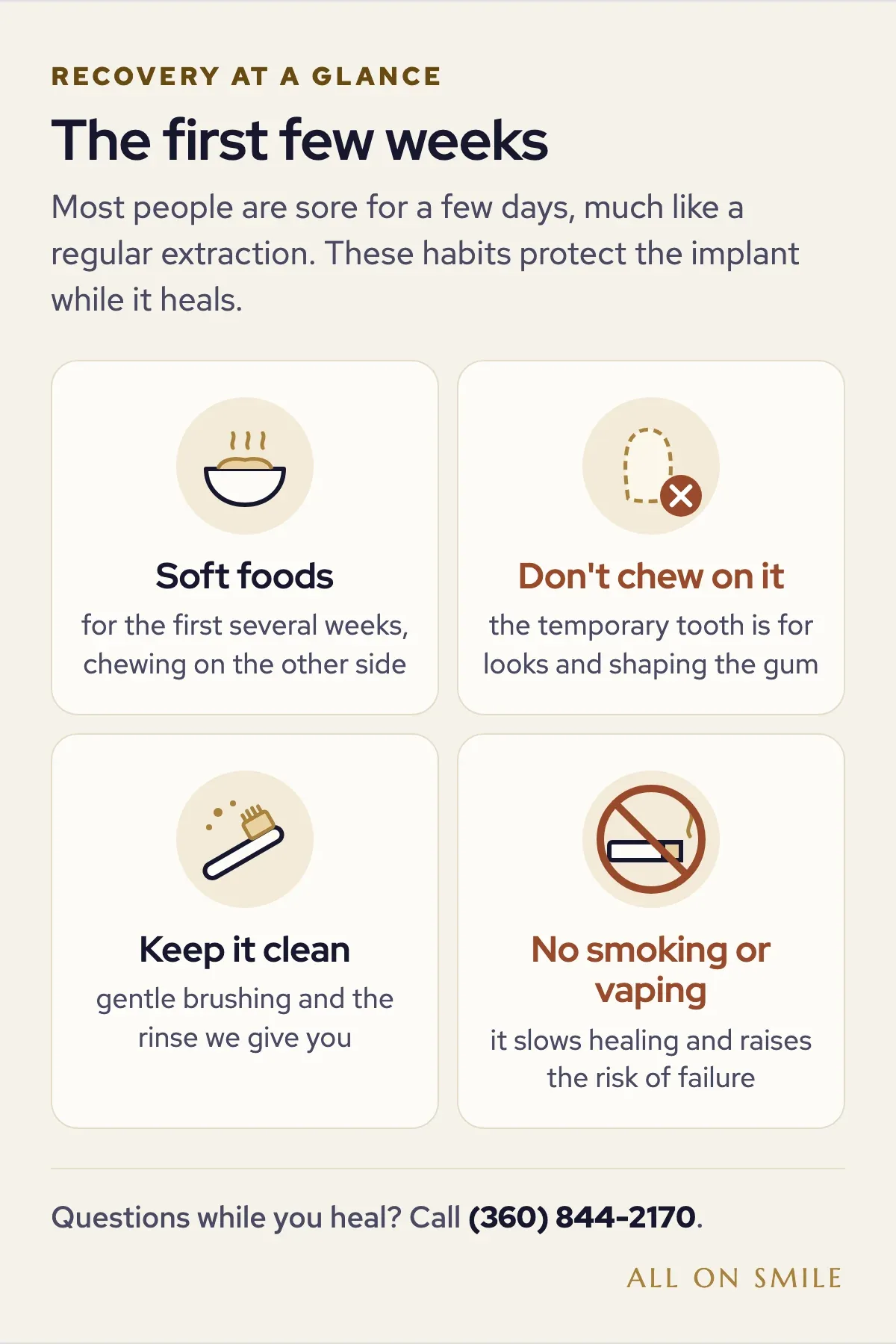
Most patients say it feels much like a regular extraction. Expect some swelling and tenderness for a few days, which most people manage well with the pain relief we recommend for you. During healing:
- Stick to soft foods for the first several weeks and chew on the other side.
- Do not bite into food with the temporary tooth. It is there for looks and to shape the gum, not for chewing.
- Keep the area clean with the gentle brushing and rinsing routine we give you.
- Avoid smoking and vaping, which slow healing and raise the risk of the implant not taking.
For a closer look at the weeks after surgery, see dental implant recovery: what to expect and our guide to eating after implant surgery.
Does an immediate implant cost more?
An immediate implant is usually priced much like a standard single implant, and because the extraction and the implant happen in one surgery, it can save you a separate surgical visit. Bone grafting and a same-day temporary crown may add to the total, depending on what your case needs. We do not bill insurance, so you get your treatment plan and a clear cost breakdown at your consultation. Our single tooth implant cost breakdown explains what goes into the price, and our article on financing implants without insurance covers payment options.
Common questions about immediate implants
Does an immediate implant hurt?
The area is fully numb during treatment, and sedation is available if you feel anxious. Afterward, most patients have mild to moderate soreness for a few days.
Can I get an immediate implant if my tooth is infected?
Sometimes. A small, long-standing infection can often be cleaned out thoroughly when the tooth is removed. A large or active abscess usually needs to clear first. Your exam and 3D scan tell us which situation you are in.
How long until I get my permanent tooth?
Usually three to six months, once the implant has fully fused with the bone.
Can several teeth be replaced this way at once?
Yes. Several teeth, and even a full arch, can be removed and replaced in the same visit when the bone supports it. Full-arch treatment is covered on our All-on-4 dental implants page.
What if the implant is not stable enough on the day?
Then we adjust the plan. Depending on what we find, we may still place the implant and cover it with a healing cap, or graft the site and place the implant once it has healed. Either way, you will know before you leave which path we took and why.
Immediate dental implants in Vancouver, WA
At All On Smile Implant & Cosmetic Dentistry, Dr. Ken Ngo, DMD, FICOI, plans every immediate dental implant with CBCT 3D imaging and makes temporary teeth in our on-site lab, so when same-day treatment is the right call, it can happen in one visit. When it is not, we will tell you plainly and explain the path that gets you the best result. Learn more about our single tooth implants and bridges.
If you have a tooth that is cracked, failing, or already scheduled to come out, ask about an implant before the extraction, not after. Call (360) 844-2170 or book a free consultation. We are open Monday through Thursday, 9am to 4pm, at 12503 SE Mill Plain Blvd, Suite 222, Vancouver, WA 98684.