


If you don’t replace a missing tooth, the bone under it slowly shrinks, the teeth beside it drift toward the gap and the tooth above or below can move into the space. A missing back tooth doesn’t hurt and nobody sees it, so it’s easy to decide it can wait. But those changes keep going, slowly, for years.
Not every gap needs to be filled. Here is what happens if you don’t replace a missing tooth, how fast, and when leaving the space alone is reasonable.
What happens in the months after a tooth comes out
A tooth sits in a ridge of bone that exists mainly to support it. Once the tooth is gone, the body starts to reshape that bone, and the teeth around the space, no longer held by a neighbor, slowly move toward the gap.
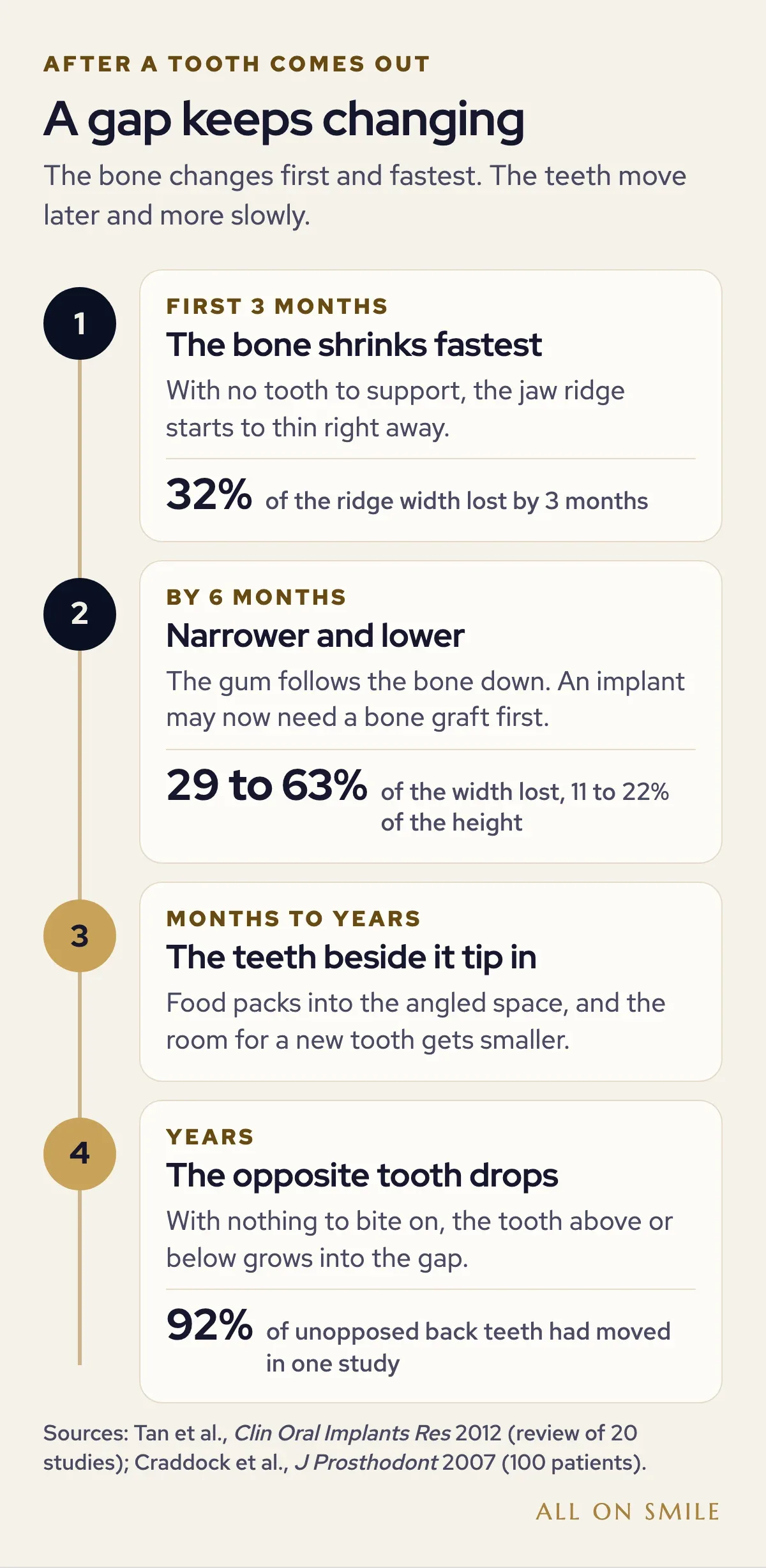
The bone changes first and fastest, in the first three to six months. Tooth movement comes later and more slowly. How much of each you get depends on where the tooth was, your gum health and how your teeth meet.
The bone under a missing tooth shrinks
This is the change you cannot see, and the one that matters most if you might want an implant one day. A 2012 systematic review of 20 studies in Clinical Oral Implants Research found that the width of the jaw ridge shrank by about 32 percent in the first three months after an extraction, and by 29 to 63 percent by six to seven months. The height dropped by 11 to 22 percent over six months.
Width matters because an implant needs bone around it on every side. When the ridge has thinned, it is still often possible to place an implant, but it may first need a bone graft, which adds a step and healing time. Our article on dental implants with bone loss explains how that is handled when the bone is already thin.
The gum follows the bone. Over a front tooth, this shows up as a dip in the gumline.
Teeth next to the gap tip and drift
Teeth stay upright partly because they lean against each other. Take one out and its neighbors tend to tip into the space.
A 2007 study of 100 patients in the Journal of Prosthodontics compared people who had lost a back tooth with matched patients who had not. The teeth on both sides of the gap were significantly more tipped, and the tooth in front of the gap was more often rotated. The tipping of the tooth behind the gap could be extreme.
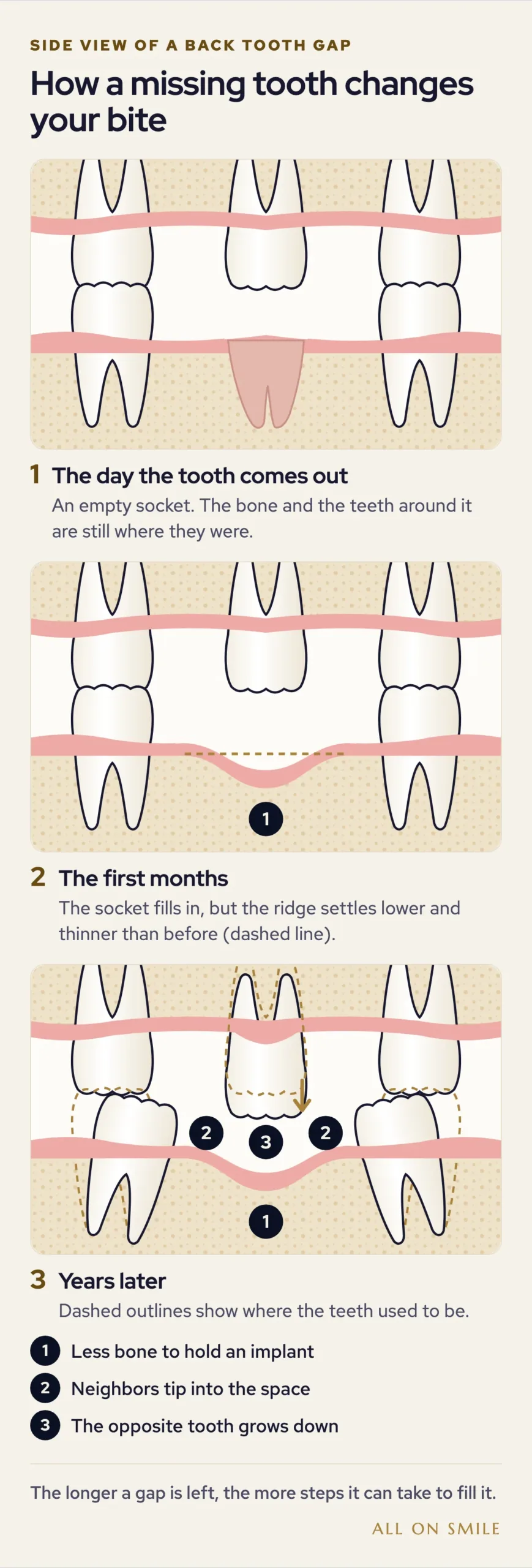
A tipped tooth leaves an angled space where food packs in and floss does not reach well, and it narrows the room for a replacement tooth. Sometimes a tipped tooth has to be moved back upright with orthodontics before a gap can be filled properly.
The opposing tooth grows into the space
Teeth keep erupting until they meet something. When the tooth it used to bite against is gone, the tooth in the opposite jaw slowly moves toward the space. Dentists call this over-eruption or supraeruption.
In part one of the same 2007 research, 92 percent of unopposed back teeth had over-erupted, by 1.68 mm on average and by almost 4 mm in some people. A tooth that has dropped a couple of millimeters can take up the vertical room a new crown needs, and it can expose more of its root as it moves.
Fixing it may mean reshaping the over-erupted tooth, or crowning it, before the missing tooth can be replaced.
Your bite and chewing change
With one tooth missing, many people chew more on the other side. Over time the remaining teeth carry more of the load, and teeth that have tipped or dropped can start to hit first when you close. Many people do not notice until a checkup or a broken filling points to it.
Losing several back teeth on the same side has a bigger effect. Chewing firm foods gets harder, and with many teeth missing, the cheeks and lips lose some of their support. A single missing tooth, on its own, does not usually change the shape of the face.
Your smile and confidence
A gap you can see is often the first thing people mention. A 2010 review of 35 studies in Health and Quality of Life Outcomes found that tooth loss was linked with worse oral health-related quality of life in all the studies it analyzed, and four of the five studies that compared locations found that missing front teeth had the larger effect.
When it is reasonable to leave a missing tooth alone
Not every gap needs a replacement. Dentists have studied people who keep their front teeth and premolars but are missing some molars at the very back, an arrangement called a shortened dental arch. A 2006 review in the Journal of Oral Rehabilitation found that, in general, these people chewed well enough and did not have more jaw joint problems, tooth migration or gum problems than people with every tooth.
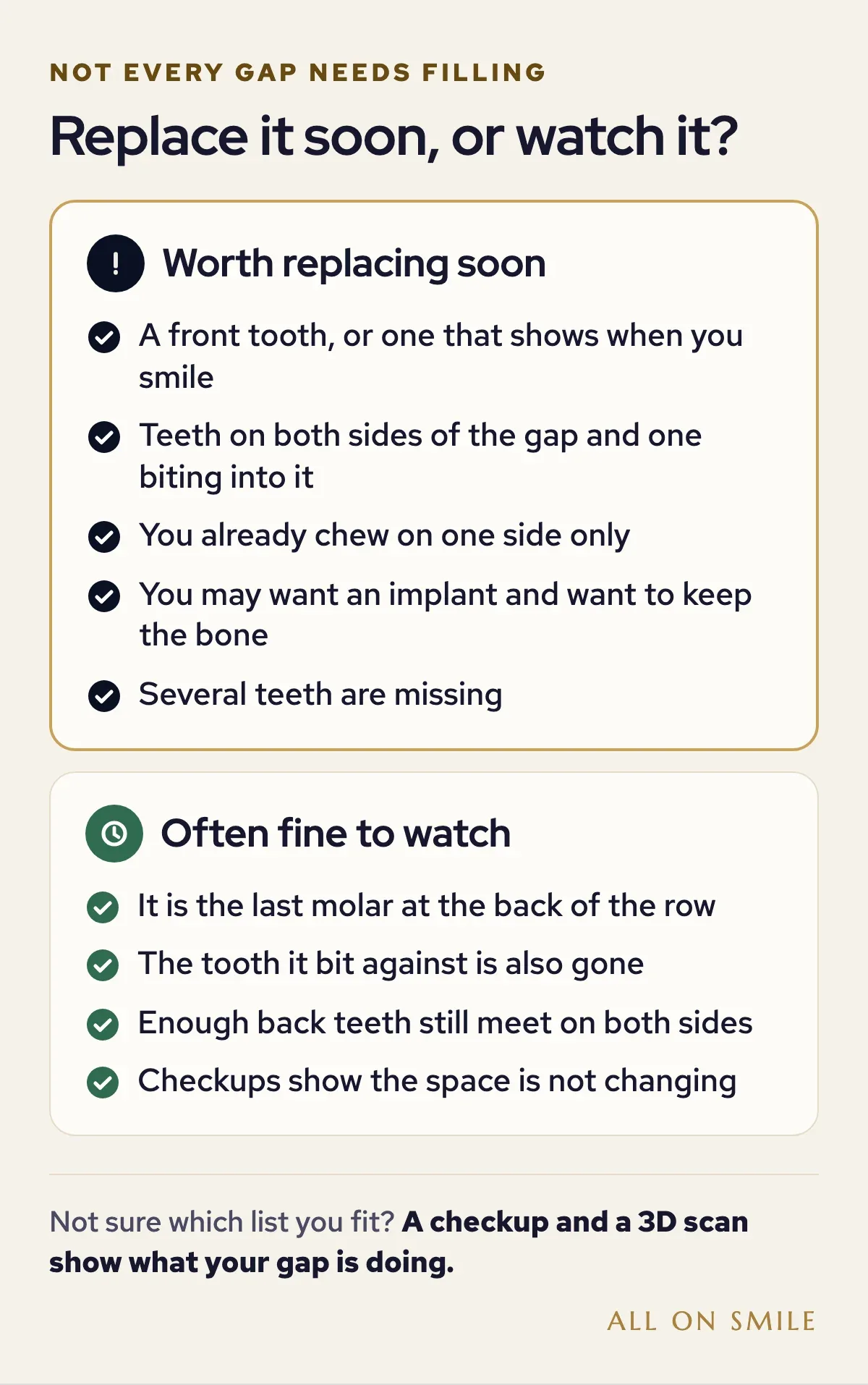
Leaving a gap is often reasonable when most of these apply:
- the missing tooth is the last molar in the row, so there is no tooth behind it to tip forward
- the tooth in the opposite jaw is also missing, so nothing can over-erupt into the space
- you still have enough back teeth meeting on both sides to chew comfortably
- the space has been checked over several visits and is not changing
Replacing the tooth sooner usually makes more sense when it is a front tooth, when there are teeth on both sides of the gap and a tooth biting into it, when you are already chewing on one side, or when you would like an implant and want to keep as much bone as possible. If several teeth are missing, the effects add up faster.
Your options for replacing a missing tooth
There are three common ways to fill a gap.
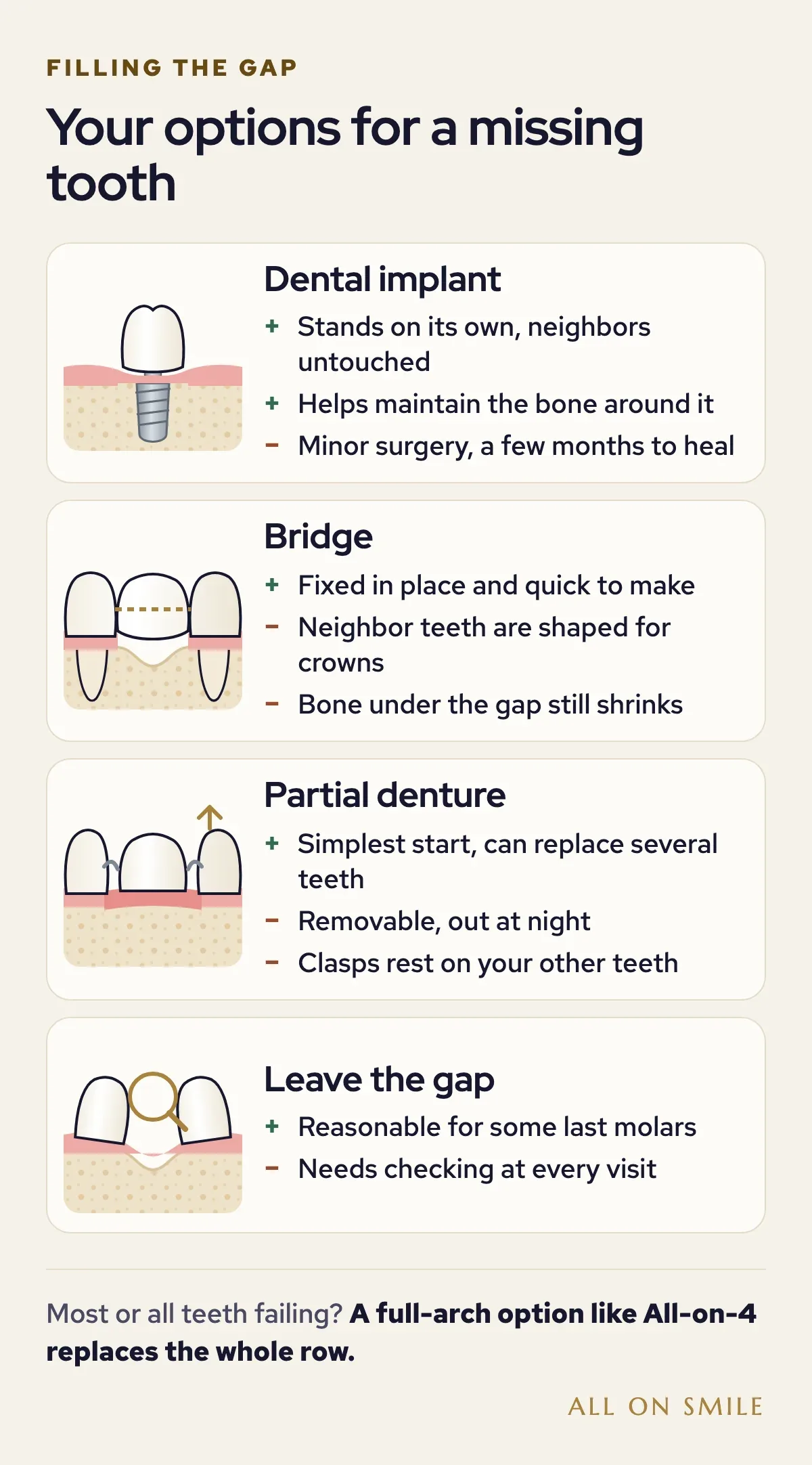
- A dental implant. A titanium post placed in the jaw with a crown on top. It stands on its own, so the teeth beside it are not touched, and it helps maintain the bone around it. Our page on single tooth implants and bridges covers how it works, and how long dental implants last covers the long view.
- A bridge. A false tooth held by crowns on the teeth on either side. It is fixed in place and quick to make, but those neighboring teeth have to be shaped for crowns, and the bone under the false tooth still shrinks. See dental implants vs. bridges.
- A partial denture. A removable plate with replacement teeth that clips onto your natural teeth. It is the simplest option to start with and can replace several teeth at once, but it comes out at night and the clasps rest on the teeth that hold it. See dental implants vs. partial dentures.
If most or all of the teeth in an arch are failing, replacing them one by one is rarely the best plan. Full-arch treatment such as All-on-4 dental implants replaces the whole row on four implants.
Does it matter how long you wait?
It can. A replacement done within the first few months, while the bone is still close to its original shape, is often the simplest version of the treatment. After several years, the same gap may need a bone graft, a crown on an over-erupted tooth, or orthodontics to upright a tipped neighbor before the replacement goes in.
The best time to plan is before the tooth comes out. In the right case, the implant can be placed in the same visit as the extraction, which can help preserve the bone from the start. Our guide to immediate dental implants explains when that works and when waiting is better. If a tooth has just broken or become painful, read about emergency extraction and implant options first.
Waiting is not always a mistake, as long as the space is checked rather than forgotten.
What about cost?
Leaving a gap costs nothing today. The trade-off is that extra steps that build up over time, such as grafting or moving teeth, add to the cost of replacing the tooth later. At All On Smile we do not bill insurance, and you get one clear plan and price after your free consultation. Our single tooth implant cost breakdown shows what goes into the price, and financing dental implants without insurance covers payment options.
Common questions about a missing tooth
How soon does the bone shrink after a tooth is pulled?
Right away. Most of the change happens in the first three to six months, when the ridge can lose about a third of its width or more. It continues more slowly after that.
Is it OK to leave a back tooth missing?
Sometimes. If it is the last molar in the row, or the tooth it used to bite against is also gone, the gap may stay stable for years. A gap in the middle of the row, with teeth on both sides and a tooth biting into it, is more likely to cause teeth to tip and drift.
Will my other teeth move if I lose a tooth?
Often, but not always, and usually slowly. The teeth beside the gap tend to tip toward it, and the tooth in the opposite jaw tends to grow into the space. Your dentist can track this by comparing scans or photos over time.
Can I still get an implant years after losing a tooth?
Usually, yes. If the bone has thinned, a bone graft can rebuild it first, and a 3D CBCT scan shows how much bone is there.
Does a missing tooth cause gum disease?
Not by itself. But teeth that tip into the gap leave angled spaces that are harder to clean, and food that packs in there can lead to decay and gum problems on those teeth.
Replacing a missing tooth in Vancouver, WA
At All On Smile Implant & Cosmetic Dentistry, Dr. Ken Ngo, DMD, FICOI, uses CBCT 3D imaging and intraoral scanning to show you how much bone you have and how the teeth around the gap sit. If leaving the space alone is a reasonable choice for you, he will tell you that. If it is not, you will get a plan with every step and one clear price. Your consultation is free, and sedation is available if you feel nervous about treatment.
Call (360) 844-2170 or book a free consultation. Our dental implant office in Vancouver is open Monday through Thursday, 9am to 4pm, at 12503 SE Mill Plain Blvd, Suite 222, Vancouver, WA 98684.