


Dental Implants vs. Bridges: Which Lasts Longer?
A side-by-side comparison to help you make the right choice for your smile
A dental implant usually lasts longer than a bridge. The implant post can last a lifetime and stands on its own, while a bridge depends on the teeth beside the gap staying healthy. Both fill the gap and let you chew and smile again, but the one you choose affects your mouth for decades.
At All On Smile Implant & Cosmetic Dentistry in Vancouver, WA, Dr. Ken Ngo helps patients in Clark County and the greater Portland metro area understand their options so they can make a confident, informed decision. Here’s the honest breakdown.
How Dental Bridges Work
A dental bridge is exactly what it sounds like: it bridges the gap left by a missing tooth. The false tooth (called a pontic) is held in place by crowns cemented onto the natural teeth on either side of the gap. These supporting teeth are called abutment teeth, and they have to be filed down significantly to accommodate the anchor crowns.
That’s the trade-off most patients don’t realize until they’re in the chair. To replace one missing tooth with a bridge, your dentist has to permanently alter two healthy teeth. The enamel that gets removed never grows back. Those abutment teeth are now dependent on the bridge for protection, and if anything goes wrong with one of them down the road, the entire bridge fails.
Bridges also sit on top of the gum line, which means the jawbone beneath the missing tooth gets no stimulation. Over time, that bone shrinks and resorbs. You might notice the gum tissue under the bridge receding, creating a visible gap that traps food and bacteria.
How Dental Implants Work
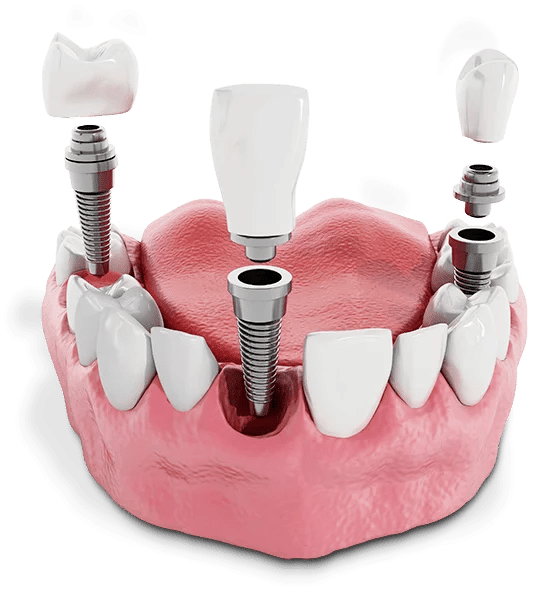
A dental implant replaces the entire tooth structure from root to crown. A small titanium post is surgically placed into the jawbone, where it fuses with the bone through a process called osseointegration. This typically takes three to six months. Once the implant is fully integrated, a custom porcelain crown is attached on top through an abutment connector.
The key difference is that an implant stands on its own. No neighboring teeth are touched, ground down, or compromised in any way. The titanium post also acts as an artificial root, stimulating the jawbone and preventing the bone loss that occurs with bridges and dentures. Your facial structure stays intact, and the surrounding teeth remain healthy and untouched.
Lifespan: Where Implants Pull Ahead
This is where the comparison gets decisive. Dental bridges typically last between 5 and 15 years. Some well-maintained bridges can stretch to 15 years, but most need replacement around the 10-year mark. The abutment teeth underneath are prone to decay at the crown margins, and the bone loss beneath the pontic can destabilize the entire structure over time.
Dental implants, on the other hand, can last a lifetime. The titanium post itself has a success rate above 95% at 20 years, and many implants placed decades ago are still functioning perfectly. The crown on top may need replacement after 15 to 25 years due to normal wear, but the implant post stays put. You’re essentially replacing a component rather than starting over from scratch.
For patients in Vancouver, WA and the Portland area who want a long-term solution, the math is clear: one implant now can save you from two or three bridge replacements over your lifetime.
The Real Cost Comparison Over Time
Bridges often appear cheaper at first glance. A traditional three-unit bridge costs between $2,000 and $5,000 depending on the materials and the practice. A single tooth implant at All On Smile costs $2,999, which includes the implant post, the abutment, and the porcelain crown.
But here’s what happens over 20 years. That bridge will likely need at least one full replacement, costing another $2,000 to $5,000. If one of the abutment teeth develops decay or cracks under the stress (which happens frequently), you’re now looking at root canals, additional crowns, or even extractions that create new gaps requiring new bridges or implants. The total 20-year cost of a bridge can easily reach $8,000 to $12,000 or more.
That $2,999 implant? It’s still there, doing its job, costing you nothing beyond regular dental hygiene. Even if the crown needs replacement once, you’re looking at roughly $4,500 to $5,000 total over the same 20 years. The implant wins on cost-per-year every time. For a deeper look at implant pricing, see our Vancouver dental implant cost guide.
Bone Preservation & Impact on Neighboring Teeth
Bone preservation is one of the most underappreciated advantages of dental implants. When a tooth is lost, the jawbone in that area begins to resorb because it’s no longer receiving the stimulation it needs from a tooth root. A bridge does nothing to stop this process. The bone continues to shrink year after year, which can affect the fit of the bridge and change the shape of your face over time.
An implant, because it sits in the bone like a natural root, keeps the bone active and healthy. Studies show that implant patients retain significantly more bone volume than bridge patients over a 10-year period. This isn’t just about aesthetics. Preserving bone now means more options later if you ever need additional dental work.
And let’s talk about the neighboring teeth. A bridge requires grinding down two healthy teeth. Those teeth are permanently compromised. Research shows that up to 30% of abutment teeth develop complications within 10 years, including nerve damage, fracture, and decay. An implant leaves your healthy teeth completely alone.
Maintenance & Daily Care
Both implants and bridges require good oral hygiene, but the daily routine differs. Bridges need special floss threaders or interdental brushes to clean underneath the pontic, where food and bacteria love to accumulate. Skipping this step leads to decay in the abutment teeth, which is the number one reason bridges fail.
Implants are maintained just like natural teeth. You brush, you floss, you see your dentist for regular cleanings. There’s no special threading required, no hard-to-reach spaces harboring bacteria. For most patients, caring for an implant is simpler and more intuitive than caring for a bridge.
Which One Is Right for You?
For the vast majority of patients, a dental implant is the better long-term investment. It lasts longer, protects your bone, doesn’t damage adjacent teeth, costs less over time, and is easier to maintain. However, bridges may be appropriate in certain situations, such as when a patient isn’t a candidate for surgery or needs a faster solution for a temporary situation.
Dr. Ken Ngo at All On Smile evaluates every patient individually with 3D imaging to determine the best approach. If you’re weighing your options in the Vancouver, WA or greater Portland area, a free consultation will give you a clear picture of what’s possible and what it will cost, with zero pressure to commit.
Still deciding whether to fill the gap at all? Here is what happens if you don’t replace a missing tooth, including when it is fine to wait.
Ready to Choose the Right Tooth Replacement?
Schedule your free consultation today. Call (360) 844-2170 or book online.